Developing a private label lash lift kit involves more than adding a logo to an existing product. Brands need to decide which formula system to use, how the treatment will be applied, what each kit should contain, and how the lotions and accessories will be packaged.
These decisions affect the product's usability, brand positioning, customization costs, and manufacturing requirements. Whether you are developing a professional salon line or an at-home lash lift kit, understanding the available options helps you create a product that fits your customers rather than relying on a standard kit configuration.
This guide explains how to customize private label lash lift kits, from formula development and individual components to branded packaging, sample approval, and bulk manufacturing.
Before choosing formulas or packaging, determine who will use your lash lift kit and how the product will be sold.
Professional Lash Lift Kits
Professional kits are designed for trained lash technicians, beauty salons, and professional beauty service providers. Product development typically focuses on predictable treatment performance, practical application methods, suitable processing times, and efficient use across multiple appointments.
Salons may prefer multi-use lotion packaging, professional application tools, and a wider selection of silicone shields to accommodate different lash lengths and desired lifting effects.
At-Home Lash Lift Kits
At-home kits are intended for individual consumers who perform treatments themselves. These products require particular attention to application complexity, portion control, understandable instructions, and potential misuse.
Single-use packaging and simplified accessory combinations may be considered when developing consumer kits. However, a convenient format or a glueless application method does not automatically make a chemical lash lift suitable for unsupervised home use. Formula safety, intended users, instructions, and market-specific requirements must be evaluated before launch.
Brands should also decide whether they want to private label an established formulation, modify an existing formula, or develop a new one. Each approach involves different levels of technical development, testing, and production planning.
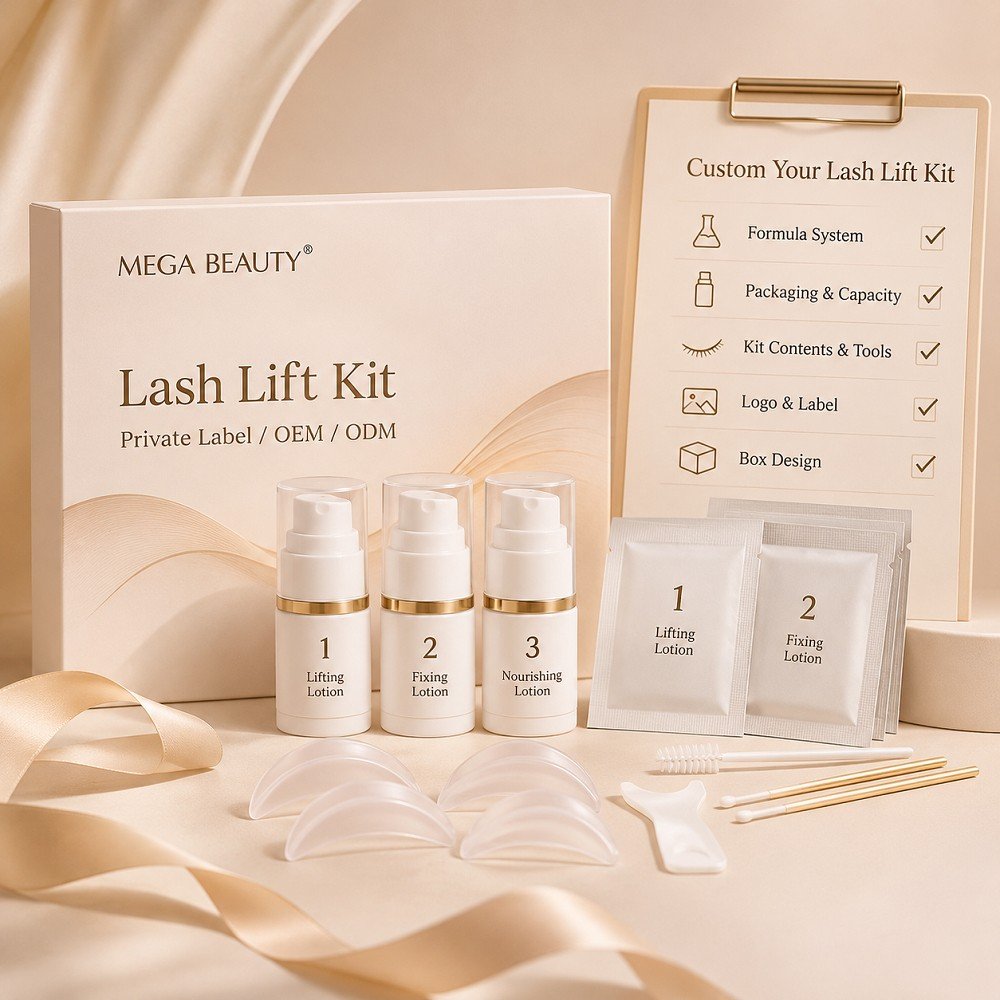
A complete lash lift kit consists of several connected elements: the chemical treatment system, lotion containers, application accessories, product labeling, and outer packaging.
The most effective approach is to develop these elements from the inside out. Start with the formula and its intended application method, then select compatible packaging and tools before finalizing the branded presentation.
Choosing the right lash lift formula involves more than selecting a lifting agent. Brands need to consider the complete treatment system, including the ingredients in each lotion, processing time, potential effects on natural lashes, compatibility between treatment steps, and regulatory requirements in their target markets.
For example, a formula designed for shorter processing times may require different application controls, while a product positioned around reduced lash damage needs appropriate testing to support that claim. Step 1 and Step 2 must also work together under the specified treatment conditions. These factors should be evaluated before deciding which formulation best fits a brand's product positioning.
Step 1 — Lifting Lotion: Choose the Reducing-Agent System
Different reducing agents are used in lash lift formulations, each offering a starting point for different product development approaches.
Taking Mega Beauty's lash lift formulation portfolio as an example, three primary reducing-agent systems are available:
Ammonium Thioglycolate: A widely used reducing agent in professional lash lifting formulations. Its processing behavior depends on the concentration, pH, and overall formulation.
Thioglycerin: An alternative reducing agent that offers another approach to developing lash lifting products with different application and processing characteristics.
Cysteamine Hydrochloride: A reducing agent used in certain modern lash lift systems, including some marketed as Korean-style treatments. Its actual performance and effects on lash condition depend on the complete formulation and application procedure.
Beyond these three primary systems, Mega Beauty has developed three additional blended formulations using combinations of the reducing agents. These formulations provide further options for brands exploring different processing speeds, reduced-damage product positioning, and differentiated formula systems.
The performance of each formulation, including processing efficiency and effects on lash condition, must be evaluated under its own recommended conditions rather than assumed from the reducing-agent combination alone.
Brands interested in the technical differences between conventional and Korean-style systems can explore our guide to Korean Lash Lift vs. Regular Lash Lift.
Step 2 — Fixing Lotion: Consider Compatibility and Regulatory Requirements
Step 2 plays a different role from the lifting lotion. After the reshaping stage, the fixing lotion uses an oxidizing system to help reform disulfide bonds and stabilize the new lash shape.
Two commonly used oxidizing agents in lash lift fixing formulations are:
Hydrogen Peroxide
Sodium Bromate
The choice between these systems involves formulation compatibility, processing performance, and regulatory considerations.
Ingredient restrictions and permitted uses can vary between countries and regions. For brands planning to distribute lash lift products internationally, the fixing lotion should therefore be selected with the target market in mind.
Mega Beauty provides fixing lotion options based on hydrogen peroxide and sodium bromate, allowing brands to explore different solutions according to their product formulations and destination markets. The applicable concentration limits, intended-use restrictions, and labeling requirements must still be confirmed for each market.
Conventional vs. Glueless Lash Lift Systems
Another important decision is whether the kit will use a conventional adhesive-assisted application method or a glueless approach.
In conventional lash lifting, adhesive or a suitable lash lift balm is commonly used to hold the natural lashes in position on the silicone shield during treatment.
Glueless lash lift systems use alternative methods to support lash positioning without the conventional adhesive step. Two approaches include:
Glueless Lash Lift Powder: A compatible thickening powder is mixed with the specified lifting or fixing lotion to modify its viscosity. The thicker mixture can help support lash positioning and controlled application without separate conventional lash glue.
Pre-Thickened Lash Lift Formulations: The lotion is developed with a thicker consistency from the beginning, reducing or eliminating the need to add a separate thickening powder. When used with compatible self-adhesive silicone shields, it can support a glueless application procedure.
These methods depend on the compatibility of the formula, powder or thickening system, and application accessories. Adding powder to an untested lotion or increasing viscosity without evaluating the complete formulation may change application behavior and treatment performance.
For brands developing at-home lash lift kits, a glueless system may be worth prioritizing because it can remove a separate adhesive application step and potentially simplify the kit configuration. However, simpler application does not eliminate the risks associated with chemical treatment near the eyes. Suitability for consumer use still requires appropriate formulation, usability, and safety evaluation.
Existing Formula or Custom Formula Development?
After determining the lifting system, fixing lotion, and application method, brands can choose their level of formulation customization:
Private labeling an existing formula: Select a developed treatment system and customize its branding and packaging.
Modifying an existing formula: Discuss feasible adjustments to application characteristics, texture, or other formulation properties, followed by the necessary evaluation.
Developing a new formula: Establish specific technical requirements and work through formulation development, compatibility testing, and sample approval.
The right approach depends on how much product differentiation a brand needs, its development budget, and the technical requirements of its intended market.
After selecting the formula, the next decision is how each lotion will be packaged.
Packaging affects dispensing, exposure to air, portion control, storage, branding options, and minimum order quantities.
Two practical options for private label lash lift products are pump bottles and single-use sachets.

Pump Bottles: Flexible for Smaller Private Label Orders
Pump bottles provide a convenient dispensing format, particularly for professional environments where products may be used across multiple treatment sessions.
One advantage of Mega Beauty's pump-bottle options is their relatively flexible minimum order requirements, making them suitable for brands testing new products or introducing multiple formulations.
However, pump-bottle packaging also has a practical limitation: lotion residue around the dispensing outlet may be exposed to air and undergo oxidation-related discoloration.
Brands and users should therefore pay attention to the dispensing procedure and avoid leaving product residue exposed unnecessarily. Dispensed lotion should be used promptly according to the product instructions rather than kept for later applications.
Discoloration at the nozzle should not automatically be treated as proof that the entire bottle has deteriorated. At the same time, product appearance alone cannot establish whether the remaining formulation is suitable for continued use. Bottle compatibility, storage conditions, and the validated period after opening should be confirmed for the individual formula.
Single-Use Sachets: Pre-Measured Portions for Individual Treatments
Single-use sachets package lotion in individual sealed portions, commonly containing an amount intended for one treatment.
This format can help users control the quantity opened for each application and reduce repeated exposure of unopened product to air.
It is particularly relevant for brands developing:
Individual treatment portions for professional salons
Compact lash lift kits
Single-treatment consumer kits
Multi-treatment kits containing separately sealed lotion portions
Single-use sachets can also simplify kit assembly because brands can specify how many treatment portions each retail box contains.
However, customized sachets generally involve higher minimum order requirements than flexible pump-bottle options. Printed sachet materials and the packaging process can influence production quantities and costs.
How Should Brands Choose Between Bottles and Sachets?
| Consideration | Pump Bottles | Single-Use Sachets |
|---|---|---|
| Typical use | Multi-use professional applications | Individual treatment portions |
| Dispensing | Product dispensed as needed | Pre-portioned contents |
| Exposure considerations | Opened packaging and nozzle residue require attention | Unopened portions remain individually sealed |
| Private label MOQ | More flexible for certain options | Generally higher for customized packaging |
| Kit planning | Capacity based on expected treatments | Number of portions per kit |
| Main consideration | Dispensing hygiene and opened-product handling | Portion size and packaging quantity |
Neither format is universally better. The choice depends on the formulation, treatment procedure, intended users, and purchasing requirements.
Customizing Lotion Capacity
Brands should also determine the appropriate amount of each lotion based on the intended number of treatments.
A professional kit may contain enough product for repeated services, while a consumer kit may be designed around a defined number of applications.
Step 1 Lifting Lotion, Step 2 Fixing Lotion, and Step 3 Nourishing Lotion do not necessarily require identical quantities. Their usage amounts should be considered individually according to the product instructions and kit configuration.
Rather than choosing a container size first, brands should begin with the intended treatment quantity and then determine the suitable packaging capacity.
Once the chemical system and lotion packaging are defined, brands can decide which components belong in the finished kit.
A lash lift kit should include everything required by its intended treatment procedure, but additional accessories should be selected for a clear practical purpose.
Core Treatment Components
The central chemical products in a lash lifting system are:
Step 1 — Lifting Lotion: Used during the reshaping stage to modify the hair's disulfide bond structure.
Step 2 — Fixing Lotion: Used to support the reformation of disulfide bonds and stabilize the lashes in their reshaped configuration.
These two stages perform distinct chemical functions and must be designed and used as a compatible system.
Step 3 — Nourishing Lotion and Lash Styling Serum
Step 3 Nourishing Lotion is commonly included in three-step lash lift kits to condition and nourish the lashes after the chemical lifting and fixing stages.
Brands can also consider a Lash Styling Serum as an alternative finishing product. In addition to providing conditioning benefits, a styling serum is formulated to help shape and hold the lashes in place, combining nourishing and styling functions in one product.
These finishing options allow brands to develop different post-treatment experiences. A traditional nourishing lotion focuses on lash conditioning, while a styling serum adds a styling function that may be useful for customers who want to maintain a more defined lash appearance.
Neither product replaces the chemical function of Step 2 Fixing Lotion. The appropriate finishing product should be selected according to the complete formulation and intended application procedure.
Application Tools and Accessories
The tools included in a kit depend on its application method.
Common options include silicone shields or rods, lash combs, Y-combs, micro brushes, applicators, and other positioning tools.
For example, silicone shields or rods are used to support lashes in the desired shape during treatment. Different dimensions and profiles can influence the lifting shape and suitability for different natural lashes.
Brands can select accessory combinations according to their intended customers rather than including every available tool.
A professional kit may benefit from multiple shield sizes and tools designed for technician-controlled application. A consumer-oriented kit may require a more limited, clearly organized selection that corresponds to its validated application procedure.
Components for Glueless Lash Lift Kits
Glueless lash lift kits require accessories that are compatible with the selected application method.
For example, brands may include self-adhesive silicone shields, which can adhere to the eyelid without requiring separate conventional lash glue. Depending on the formulation, the kit may also use a compatible Glueless Lash Lift Powder or a pre-thickened lotion to help maintain lash positioning during treatment.
These components should be evaluated together. The shield's adhesion, the lotion's consistency, and the application procedure all affect how the lashes are held in position.
For at-home kit development, combining a suitable glueless system with a simplified accessory selection may reduce the number of application steps. However, the finished kit still needs appropriate instructions, safety precautions, and validation for its intended users.
Essential Components vs. Brand-Differentiating Accessories
A useful way to develop kit contents is to separate functional requirements from optional additions.
| Kit Component | Role in Product Development |
|---|---|
| Lifting Lotion | Core chemical treatment |
| Fixing Lotion | Core chemical treatment |
| Compatible positioning tools and required application materials | Essential to the specified application procedure |
| Nourishing Lotion or Lash Styling Serum | Post-treatment conditioning and optional styling functions |
| Additional shields or rods | Expanded application options |
| Extra combs, brushes, or applicators | Convenience and accessory configuration |
| Aftercare products | Optional product-range extension |
| Branded inserts or accessory presentation | Retail branding and organization |
The finished kit must still provide the instructions, warnings, and any required protective or application materials identified for its intended use.
Brands should not assume that adding more accessories automatically increases the value of a kit. Components are most useful when they improve the intended application experience or support a clear product positioning.
Once the formulas, containers, and kit contents have been selected, brands can develop the visual identity of the products themselves.
Private label customization may include brand logos, product names, color schemes, ingredient information, usage directions, and other required labeling.
For lotion bottles and compatible packaging formats, two common branding approaches are custom adhesive labels and direct printing.
Custom Stickers and Labels
Custom labels usually offer greater flexibility for smaller orders because the container itself does not need a separate branded printing process.
They are useful for:
New brands testing a product line
Small private label orders
Multiple formulas with different product names
Brands that expect to update packaging artwork
Products sold in several language versions
Labels can be designed to create a consistent appearance across Step 1, Step 2, and Step 3 while allowing different product information to appear on each container.
However, label materials, adhesion, moisture resistance, and compatibility with the container surface should be considered during development.
Direct Printing on Product Packaging
Direct printing applies branding to the container or packaging material through a printing process appropriate for that format.
It can provide a more integrated appearance without relying on a separately applied adhesive label.
Direct printing generally requires a higher minimum order quantity because of printing setup and material production requirements.
It may be more suitable for established brands ordering consistent packaging designs in larger quantities.
| Branding Method | Custom Labels | Direct Printing |
|---|---|---|
| MOQ | Generally more flexible | Generally higher |
| Artwork changes | Easier to update between orders | May involve additional setup |
| Multiple SKUs | Convenient for varied product information | Requires planning for each design |
| Appearance | Depends on label material and application quality | Integrated printed appearance |
| Typical use | New launches and smaller orders | Established product lines and larger orders |
Neither method is inherently higher quality in every application. The finished result depends on the materials, printing process, and quality control.
For brands entering the market with several lash lift formulations, custom labels can be a practical way to introduce different products without committing to large quantities of individually printed containers.
As order volumes become more predictable, direct printing can be evaluated as an alternative.
The outer packaging is the final layer of private label kit development.
By this stage, the formula, lotion containers, accessories, and intended treatment quantity should already be defined. These decisions determine the dimensions and internal arrangement of the retail box.
Custom Box Design
Brands can customize the outer box through elements such as:
Brand colors and graphic design
Product names and logos
Custom box dimensions
Printed instructions and product information
Selected surface finishes and printing effects
The design should reflect the intended sales channel. A professional salon kit may emphasize practical organization and clear product identification, while a consumer retail kit may require more space for instructions and product information.
Internal Layout and Component Arrangement
The internal structure should keep the lotion containers and accessories organized and adequately protected during storage and transportation.
A kit containing pump bottles will have different dimensional requirements from one containing single-use sachets.
Likewise, adding more silicone shields, brushes, or treatment portions can change the required box size and internal arrangement.
These details should be finalized before approving the box structure and artwork.
Printing and Finishing Options
Outer packaging can also be differentiated through printing and finishing choices, such as matte or gloss finishes, embossing, foil stamping, and other decorative treatments where available.
These choices affect appearance, cost, and production requirements. They should support the intended brand positioning rather than being added without a practical or visual purpose.
Mega Beauty supports private label lash lift kit development across the product and packaging stages, allowing brands to coordinate formula selection, lotion packaging, accessory combinations, product labels, and outer box customization within one project.
The objective is to create a coherent finished kit, not simply assemble independently branded components.
Before placing a bulk order, brands should evaluate samples of both the treatment system and the completed kit.
A suitable sample review should examine more than the appearance of the packaging.
Formula and Application Performance
Confirm that the selected Step 1 and Step 2 products match the agreed specifications and are evaluated under their documented application conditions.
When comparing formulas, consider the complete treatment procedure, including processing instructions, natural lash condition, application method, and observed results.
Different formulations should not automatically be compared using identical processing times. A faster result also does not, by itself, demonstrate better performance or lower risk of damage.
Packaging and Dispensing
Test the actual lotion containers for practical use, sealing, dispensing, and compatibility with the formula.
For pump bottles, evaluate how the dispensing outlet performs during repeated use and how exposed residue should be handled. For single-use sachets, review portion size, seal integrity, and opening convenience.
Kit Completeness and Usability
Confirm that every component corresponds to the approved kit configuration.
Professional kits should be reviewed for suitability within their intended technician workflow. For consumer products, instructions, application complexity, packaging, warnings, and foreseeable misuse require additional attention.
Final Sample Approval
Before mass production, brands should approve the final formula specification, container format, kit contents, labels, artwork, and outer packaging.
These approved details should form the reference for subsequent production and quality checks.
Once the formula, kit contents, and packaging are finalized, brands should confirm the production requirements before placing a bulk order.
Minimum Order Quantities
MOQ varies depending on the level of customization. Existing formulas with standard bottles and custom labels generally offer more flexible ordering options, while new formula development, printed sachets, and customized packaging may require higher quantities.
Brands should confirm the minimum order requirements for each component rather than assuming one MOQ applies to the entire kit.
Compliance and Product Documentation
Regulatory requirements depend on the formula, intended users, and destination market. Brands should confirm applicable ingredient restrictions, labeling requirements, safety documentation, and any additional obligations before launching their products.
Professional salon kits and consumer at-home kits may have different requirements, particularly regarding chemical ingredients, permitted uses, instructions, and warnings.
Bulk Production and Quality Consistency
Before production, approve the final formula specifications, lotion packaging, accessories, labels, and box artwork.
These approved details should serve as references for manufacturing and quality checks, helping maintain consistency between samples, initial bulk orders, and future repeat purchases.
Mega Beauty provides OEM/ODM and private label development services for lash lift brands, wholesalers, distributors, and professional beauty businesses.
Our lash lift portfolio includes six developed reducing-agent formulation routes based on Ammonium Thioglycolate, Thioglycerin, Cysteamine Hydrochloride, and their paired combinations. Professional salon-oriented and glueless application versions offer additional options for product development, subject to the requirements of the intended use.
Brands can choose from existing formulations, discuss formula modifications, or explore new formulation development. Customization also covers lotion capacity and packaging, treatment accessories, product labels, instructions, and branded retail boxes.
Explore our Lash Lift & Brow Lamination Wholesale collection to review available product options and discuss your customization requirements.
Whether you are creating a professional lash lift product line or exploring an at-home kit concept, the development process should begin with the intended users, product specifications, and target market requirements.
Share your preferred formula system, kit configuration, packaging ideas, and estimated order quantity with Mega Beauty to discuss a private label lash lift solution for your brand. You can also explore our broader Private Label Lash Manufacturing Services for additional branding and product development options.
Laoshan Road, Laoshan District, Qingdao City,Shandong Province
Copyright © 2025 Qingdao Mega Beauty Lashes Co., Ltd. All Rights Reserved.
