
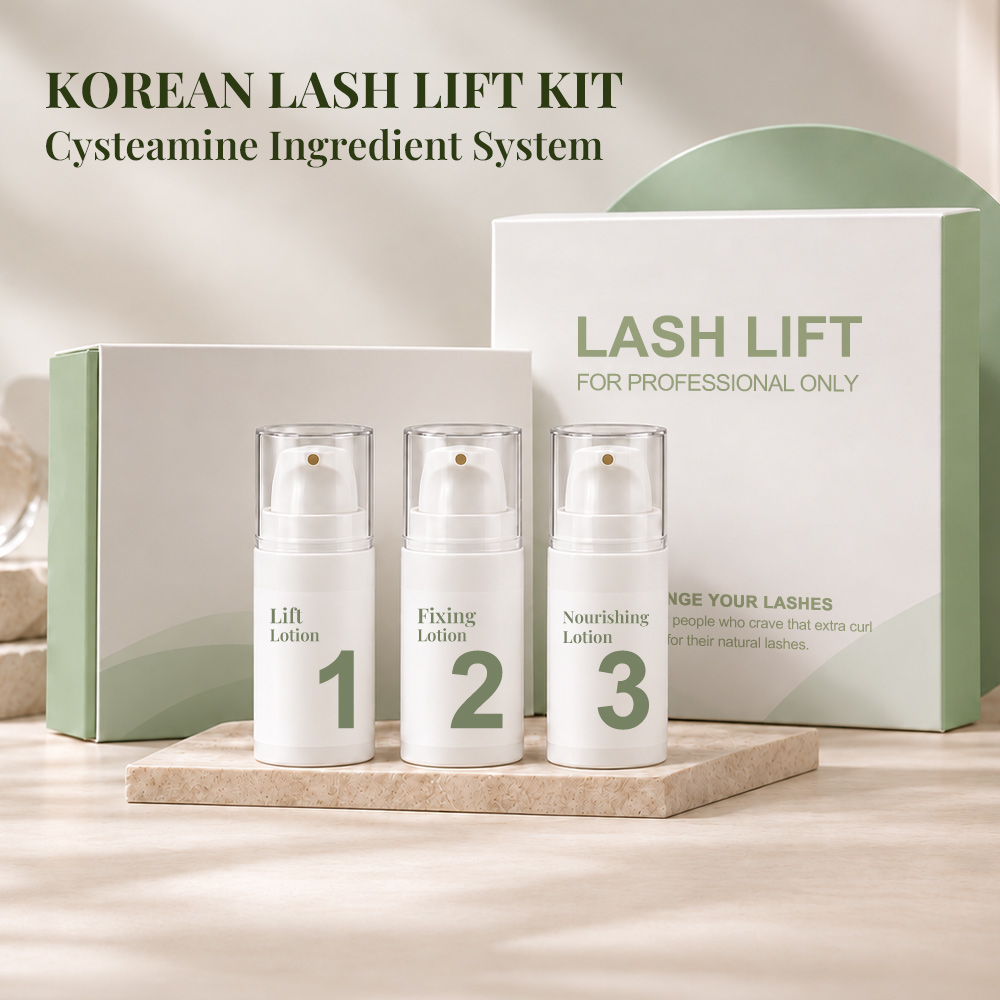
A Korean lash lift is a type of professional lash lift commonly associated with cysteamine-based formulations, gentler processing approaches, and natural-looking lash enhancement. In the beauty industry, professional lash lift systems that emphasize these characteristics are often marketed as Korean lash lifts, although the term does not represent a universally standardized formulation or treatment method.
Unlike traditional thioglycolate-based systems, many Korean lash lift products use cysteamine hydrochloride as their primary reducing agent. These formulations are often developed to support controlled lash reshaping with an emphasis on minimizing unnecessary hair damage. They may also require longer processing times than rapid lash lift systems. The resulting lifted appearance can generally remain visible for more than 30 days, depending on the formulation, natural lash growth cycle, and treatment conditions.
A Korean lash lift is a professional eyelash treatment that reshapes natural lashes into an upward lift or curl without adding artificial lash extensions. Like other lash lift treatments, it changes the curvature of existing eyelashes rather than increasing their actual length or thickness.
What distinguishes Korean lash lifts in the professional beauty market is primarily their formulation philosophy and treatment positioning, rather than a completely different chemical lifting mechanism.
One of the most recognizable characteristics of Korean lash lift products is the use of cysteamine-based reducing agents, particularly cysteamine hydrochloride.
Cysteamine hydrochloride works by reducing some of the disulfide bonds within the keratin structure of natural eyelashes, allowing the lashes to be reshaped. It provides an alternative to ammonium thioglycolate, a reducing agent commonly found in traditional and rapid lash lift systems.
Many professional brands position cysteamine-based formulations as a gentler approach to lash lifting. However, the actual effect on the hair depends on the complete formulation, including reducing-agent concentration, pH, processing time, and other ingredients.
Not every product marketed as a Korean lash lift necessarily uses the same reducing agent. The term describes a market-recognized product approach rather than a fixed ingredient standard.
Korean lash lift systems are often developed and marketed with an emphasis on controlled chemical processing and preserving the appearance and condition of natural eyelashes.
Compared with more aggressive processing conditions, appropriately formulated and applied cysteamine-based systems may help limit visible changes to the lash hair structure. However, reduced damage cannot be guaranteed simply because a product contains cysteamine hydrochloride or carries the Korean lash lift label.
The actual outcome depends on the formulation and how it is used. Excessive processing, unsuitable treatment conditions, or repeated chemical exposure can still contribute to dryness, brittleness, and hair damage.
For professional brands and lash technicians, the important consideration is whether a formulation provides effective reshaping while maintaining an appropriate balance between processing performance and lash condition.
Another common characteristic of cysteamine-based Korean lash lift systems is their processing time.
Some professional cysteamine-based lifting lotions use a Step 1 processing window of approximately 10–15 minutes, depending on the formulation and the condition of the natural lashes. Mega Beauty's Korean lash lift system, for example, has recommended processing conditions within this range.
By comparison, certain rapid thioglycolate-based systems are designed for shorter processing times.
However, longer processing is not a universal requirement for every Korean lash lift product. Different formulations may have different recommended times, and extending the processing period beyond the manufacturer's instructions does not necessarily improve the result.
The processing time should always be determined by the specific product system rather than the Korean lash lift name alone.
The appeal of Korean lash lifts comes from the combination of natural lash enhancement and the formulation characteristics commonly associated with this professional treatment category.
Cysteamine-based Korean lash lift systems provide professional technicians and beauty brands with another formulation option beyond traditional thioglycolate-based products.
The different reducing-agent chemistry allows manufacturers to develop products with distinct pH profiles, processing requirements, and formulation characteristics.
This gives professional users more flexibility when selecting a lash lift system, although the performance and suitability of individual formulations must be assessed separately.
A major selling point of Korean lash lift systems is their focus on controlled reshaping while limiting unnecessary chemical stress on natural eyelashes.
Certain cysteamine-based formulations may produce less visible disruption to the lash hair surface under particular testing conditions. Nevertheless, this should not be interpreted as proof that every Korean lash lift is less damaging than every traditional formulation.
Product-specific testing, appropriate processing times, and the condition of the natural lashes remain essential considerations.
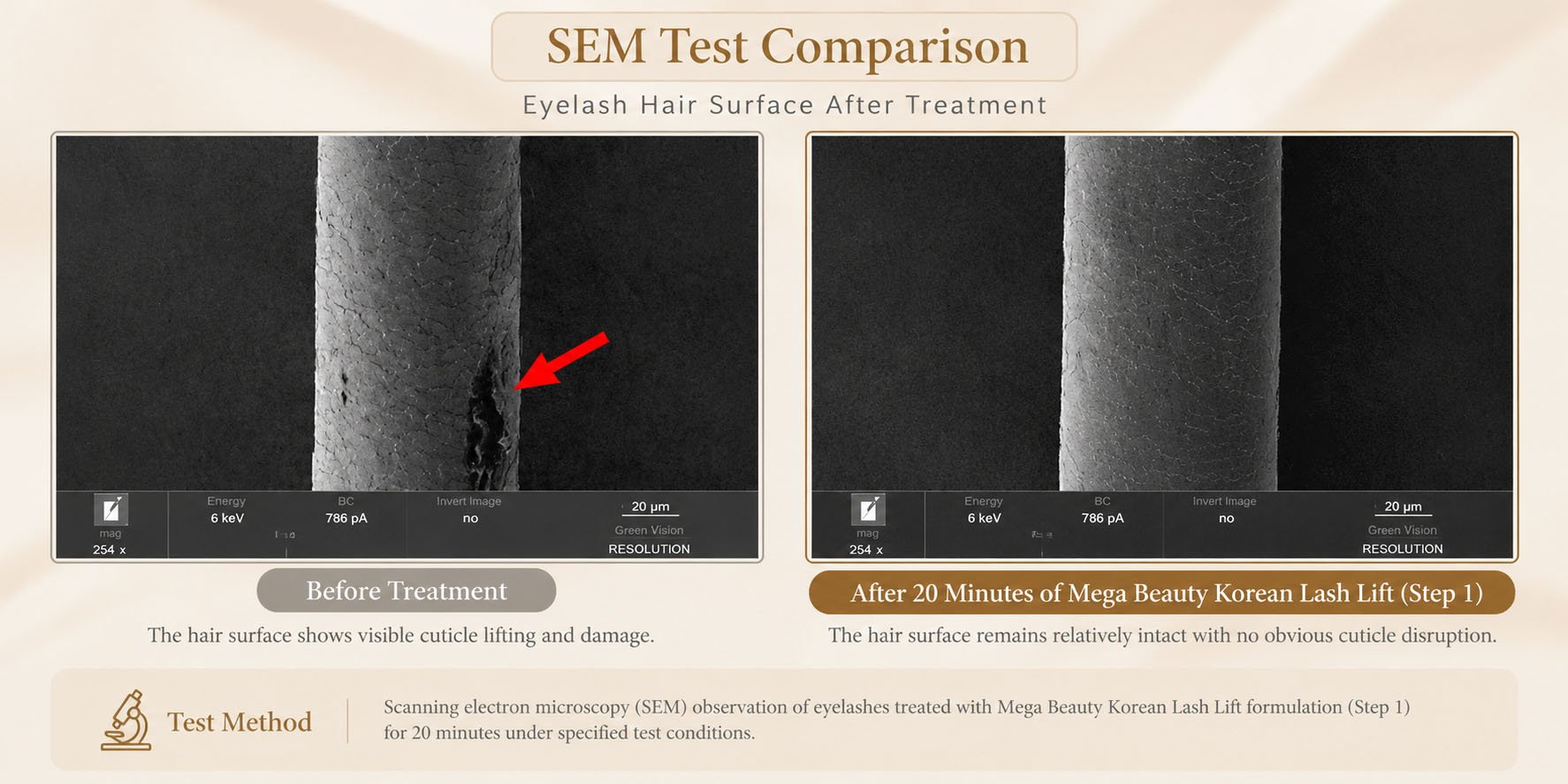
To evaluate the effects of its own formulation, Mega Beauty conducted scanning electron microscopy (SEM) testing on eyelashes treated with Mega Beauty's cysteamine-based Korean Lash Lift. Even after 20 minutes of exposure, the treated samples showed no obvious cuticle disruption, with the hair surface remaining relatively intact under microscopic observation. These findings reflect the tested performance of Mega Beauty's specific Korean Lash Lift formulation, rather than a general claim about all Korean lash lift products.
Korean lash lifts can create a range of natural-looking results, from a subtle upward lift to a more noticeable curl.
The treatment enhances the appearance of existing eyelashes without attaching additional lash fibers. Straight or downward-growing lashes may appear longer and more defined once they are lifted.
As with other professional lash lift systems, the final result depends on the natural lash characteristics, silicone shield selection, and application technique.
A Korean lash lift chemically reshapes natural eyelashes, allowing the lifted appearance to remain visible for weeks rather than producing the temporary effect of a mechanical eyelash curler.
However, longer-lasting results are not an inherent advantage of Korean formulations over other professional lash lift systems. Actual retention depends on the formulation, treatment conditions, and natural eyelash growth cycle.
Korean lash lifts use the same fundamental chemical reshaping mechanism as other professional lash lift treatments.
Natural eyelashes contain keratin proteins held together partly by disulfide bonds. A lifting formulation uses reducing agents to break some of these bonds, making the lashes flexible enough to reshape. A subsequent setting formulation helps the bonds reform while the lashes are held in their new curvature.
In many Korean lash lift systems, cysteamine hydrochloride performs the reducing function during the lifting stage. The specific formulation determines how the lashes respond and the recommended processing time.
Silicone shields or rods are used to establish the desired lift and curl, while compatible setting products stabilize the reshaped lashes. Nourishing or finishing treatments may then be used to condition the lashes.
The fundamental treatment stages are similar to those of other professional lash lift systems. The main differences lie in formulation chemistry, processing characteristics, and recommended processing times, rather than an entirely different sequence of chemical steps.
For a detailed explanation of the lifting, shaping, setting, and nourishing stages, see our guide to how a lash lift works.
A Korean lash lift can generally remain visible for more than 30 days, although the actual duration varies between individuals and product systems.
The treatment reshapes existing natural eyelashes, but it does not permanently change how new lashes grow. As treated lashes gradually shed and new lashes grow in with their original curvature, the overall lifted appearance becomes less noticeable.
This process is gradual, so the result typically fades as the natural eyelashes are replaced rather than disappearing at a specific point in time.
Several factors influence how long a Korean lash lift remains noticeable.
Natural lash growth cycle. Eyelashes grow and shed at different rates. As treated lashes are replaced by new growth, the visible lift gradually decreases.
Natural lash characteristics. The original length, thickness, growth direction, and condition of the eyelashes influence how the lifted result appears over time.
Product formulation and processing conditions. The reducing agent, formulation pH, processing time, and effectiveness of the setting stage all contribute to establishing the new curvature.
Lash shaping technique. Silicone shield selection and lash positioning affect the initial lifting result, which can influence how the appearance changes as the lashes grow.
Aftercare. Following the recommendations for the specific product system can help maintain the appearance and condition of treated lashes.
Not necessarily. Although Korean lash lift systems often differ from traditional formulations in their reducing agents and processing requirements, these differences do not automatically translate into longer-lasting results.
A cysteamine-based Korean lash lift may require more processing time than a rapid thioglycolate-based system, but a longer treatment time does not establish better retention.
The duration of the result depends on the complete formulation, the treatment procedure, and the individual's natural lash growth cycle.
Korean and regular lash lifts are both professional treatments designed to reshape natural eyelashes. The main differences are generally related to their formulation chemistry and processing characteristics.
| Feature | Korean Lash Lift | Traditional / Rapid Lash Lift |
|---|---|---|
| Common reducing agent | Cysteamine hydrochloride | Ammonium thioglycolate |
| Processing time | Often longer, depending on the formulation | Often shorter in rapid systems |
| Formulation positioning | Controlled processing and lash condition | Efficient lifting and processing speed |
| Potential hair damage | Often formulated with an emphasis on minimizing hair damage | May produce greater cuticle disruption under certain processing conditions |
| Expected result | Lifted and curled natural lashes | Lifted and curled natural lashes |
Note: These are general formulation tendencies, not guaranteed performance differences. Actual hair damage depends on the complete formulation, processing time, lash condition, and application technique.
These are common product distinctions rather than universal rules. Formulations marketed under either category can vary significantly.
A Korean lash lift is therefore not automatically safer, more effective, or longer-lasting than a regular lash lift. The most suitable system depends on the specific product formulation, natural lash condition, and professional treatment requirements.
For a more detailed comparison of ingredients, processing characteristics, and product selection, see our Korean Lash Lift vs Regular Lash Lift guide.
Korean lash lifts can appeal to both professional beauty service providers and clients who prioritize natural lash enhancement and a condition-conscious treatment approach.
Korean lash lift systems can be an attractive option for salons looking to introduce premium lash treatments that emphasize formulation quality and natural lash care.
Certain cysteamine-based systems have longer recommended processing times than rapid lash lift formulations, which may offer more flexibility when planning salon appointments and managing several clients during busy service periods.
However, a longer processing time should not be confused with an unlimited or automatically more forgiving processing window. Technicians must still monitor each treatment and follow the manufacturer's recommended timing and application procedures.
For salons developing premium service menus, Korean lash lifts can also support a differentiated treatment offering that emphasizes controlled processing, lash condition, and personalized styling rather than speed alone.
In Mega Beauty's SEM observations, eyelashes treated with its Korean lash lift formulation for 20 minutes showed no obvious cuticle disruption under the tested conditions. This provides additional insight into the formulation's hair-surface performance, although the recommended Step 1 processing time remains 10–15 minutes and should not be extended solely on the basis of this test.
Korean lash lifts may appeal to clients who prefer a formulation approach focused on minimizing unnecessary chemical stress rather than achieving the shortest possible processing time.
They can be particularly relevant to clients who have naturally straight or downward-growing lashes and want a lifted appearance without extensions, as well as those who place greater importance on the condition of their natural eyelashes.
Clients concerned about lash sensitivity or previous chemical treatments may also wish to discuss cysteamine-based options with a qualified lash technician. However, a gentler formulation positioning does not guarantee suitability for sensitive individuals, and chemical lash lift products can still cause irritation or damage.
If the natural lashes are already visibly damaged, brittle, or overprocessed, a professional assessment is necessary before proceeding. In some cases, postponing the treatment may be more appropriate than selecting a different lifting formula.
No. Cysteamine hydrochloride is commonly associated with Korean lash lift products, but the term Korean lash lift does not have a universally standardized ingredient definition. The actual reducing agents and formulation characteristics should be verified for each product.
Many Korean lash lift systems use cysteamine hydrochloride as their primary reducing agent, while traditional rapid lash lifts commonly rely on ammonium thioglycolate. These reducing agents have different chemical properties and are formulated under different processing conditions, which can influence how quickly they modify disulfide bonds within the lash hair.
As a result, some cysteamine-based Korean lash lift formulations require longer processing times to achieve the intended reshaping effect. For example, Mega Beauty's Korean lash lift system has a recommended Step 1 processing time of approximately 10–15 minutes, compared with 5–7 minutes for certain rapid thioglycolate-based systems.
These differences reflect the specific formulation chemistry and recommended treatment conditions, rather than a universal timing rule for all Korean lash lift products.
Certain cysteamine-based formulations may help limit visible hair damage under specific conditions, but the Korean lash lift label alone does not guarantee reduced damage. The complete formulation, pH, processing time, and application technique determine the treatment's effects on natural lashes.
The appropriate interval depends on the natural lash growth cycle, lash condition, and manufacturer's recommendations. Previously treated lashes should be assessed before another chemical treatment, and repeated processing should not be based solely on how quickly the visible curl begins to fade.
Professional Korean lash lift formulations are intended for trained beauty technicians and should not automatically be used for self-application. Products specifically developed for at-home use belong to a separate consumer product category and require appropriate evaluation, instructions, and warnings.
No. A Korean lash lift does not increase the actual length or number of natural eyelashes. By changing their curvature, it can make more of their existing length visible, creating a longer-looking and more defined appearance.
A Korean lash lift is a type of professional lash lift commonly associated with cysteamine-based formulations, controlled processing, and an emphasis on maintaining natural lash condition. While it shares the same fundamental lifting mechanism as other professional lash lift treatments, its formulation characteristics and recommended processing times may differ.
Korean lash lift results can generally remain visible for more than 30 days, although actual duration depends on the natural lash growth cycle, product formulation, treatment conditions, and aftercare.
For beauty professionals and brands, understanding the specific formulation is more important than relying on the Korean lash lift name alone.
Mega Beauty offers professional Korean lash lift products based on cysteamine hydrochloride, along with wholesale supply, customizable product combinations, and private label solutions for beauty brands, distributors, and professional lash suppliers.
No.18 B, Laoshan Road, Laoshan District, Qingdao City,Shandong Province
Copyright © 2025 Qingdao Mega Beauty Lashes Co., Ltd. All Rights Reserved.
