
Korean lash lifts and regular lash lifts both reshape natural eyelashes to create a lifted, curled appearance. The main difference lies in their formulation approaches, processing characteristics, and potential impact on natural lash condition.
Korean lash lift systems commonly use cysteamine-based formulations that emphasize gentler processing and minimizing hair damage. Traditional lash lifts typically use thioglycolate-based formulations, many of which are developed for efficient lifting and shorter processing times. Both systems can achieve excellent visual results, but Korean lash lifts are increasingly favored by professionals who prioritize natural lash condition and greater flexibility during processing.
| Comparison | Korean Lash Lift | Regular Lash Lift |
|---|---|---|
| Common Step 1 reducing agents | Often cysteamine-based; some use blended systems | Commonly thioglycolate-based |
| Formulation approach | Gentler, more controlled chemical processing | Efficient, predictable lifting performance |
| Lash damage potential | Often designed to minimize cuticle disruption | May cause more noticeable cuticle changes, depending on formulation |
| Step 1 processing time | Commonly around 8–15 minutes, depending on product | Often shorter with rapid formulations; varies by product |
| Processing flexibility | Some gentler formulations provide a wider working window | Faster formulations may require closer timing control |
| Application technique | Conventional or glueless methods with compatible accessories | Conventional or glueless methods with compatible accessories |
| Final lash appearance | Natural lift or defined curl | Natural lift or defined curl |
| Lift longevity | Depends on the complete treatment system and natural lash cycle | Depends on the complete treatment system and natural lash cycle |
These comparisons describe common industry formulation approaches rather than fixed technical standards. Actual performance varies among products and manufacturers.
A Korean lash lift is a professional eyelash lifting approach that emphasizes gentle chemical processing and maintaining the condition of natural lashes while achieving an effective lift.
Many Korean lash lift systems use cysteamine hydrochloride as the primary reducing agent in their Step 1 lifting lotion. Cysteamine modifies disulfide bonds within the hair, allowing natural lashes to be reshaped before the setting stage. Compared with some conventional thioglycolate-based formulations, cysteamine systems are often designed for more gradual processing, helping reduce excessive chemical stress on the lash fibers.
However, Korean lash lift is not a standardized chemical formula. Different manufacturers may use cysteamine, combined reducing agents, or other formulation approaches to achieve their intended processing characteristics.
Like regular lash lifts, Korean systems can use conventional adhesive-based placement or glueless techniques supported by compatible lash lift powder and accessories. The placement method is separate from the chemical properties of the Step 1 lotion.
The main appeal of Korean lash lifting is not a fundamentally different curl or lifting effect, but its emphasis on gentler processing and preserving natural lash condition.
A regular lash lift, also known as a traditional or conventional lash lift, is a professional treatment that chemically reshapes natural eyelashes into a lifted or curled position.
Traditional lash lift systems commonly use thioglycolate-based reducing agents, such as ammonium thioglycolate, in their Step 1 lifting lotions. These ingredients modify disulfide bonds within the hair, allowing the lashes to be reshaped. Step 2 is then used to support bond reformation and stabilize the new lash position.
Thioglycolate-based formulations are widely used because they can provide effective, predictable lifting results. Many rapid lash lift systems are also designed for shorter processing times, making them attractive to professional salons seeking greater treatment efficiency.
However, chemical reshaping changes the hair's internal bond structure and can also affect the cuticle surface. The extent of these changes depends on the formulation, processing conditions, and individual lash characteristics. More aggressive or prolonged processing may lead to raised cuticle scales, surface irregularities, brittleness, or breakage.
This does not mean regular lash lifts are unsuitable for professional use. Well-developed traditional systems can deliver excellent lifting results, while appropriate formulation design and processing control help limit unnecessary hair damage.
The term "regular" distinguishes conventional lash lifting systems from newer approaches rather than representing a standardized chemical formula or damage classification.
Both systems use chemical reduction and setting to reshape natural lashes, but their formulation priorities and processing characteristics can differ.
One of the main technical differences is the reducing agent used in Step 1.
Traditional lash lift formulations commonly rely on thioglycolate-based ingredients, particularly ammonium thioglycolate, to efficiently modify disulfide bonds within the hair.
Korean lash lift systems are more commonly associated with cysteamine hydrochloride, which can be incorporated into formulations designed for gentler, more gradual processing.
Both ingredients chemically reshape the hair, but they have different reaction characteristics and formulation requirements. Some manufacturers also combine cysteamine and thioglycolate to achieve particular processing properties, so the distinction between Korean and regular systems is not always absolute.
For example, Mega Beauty's Korean Lash Lift uses a cysteamine-based Step 1 formulation, while its Classic and Rapid Lash Lift range includes thioglycolate-based and hybrid systems.
Gentleness is one of the most important differences between Korean and regular lash lift systems.
Traditional thioglycolate-based formulations can reshape lashes efficiently, but certain formulations and processing conditions may cause more noticeable cuticle disruption. Excessive chemical exposure can further increase the risk of weakened or brittle lashes.
Cysteamine-based Korean lash lift systems are often developed with greater emphasis on preserving cuticle integrity and reducing unnecessary chemical stress. Their more gradual processing characteristics may help minimize overprocessing risks, particularly when used under appropriate conditions.
This makes gentleness an important consideration for professionals choosing between the two systems. The actual level of hair damage still depends on the complete Step 1 formulation, processing conditions, and individual lash characteristics.
Traditional lash lift systems are often designed with treatment efficiency in mind. Rapid thioglycolate-based formulations can achieve effective lifting within relatively short processing times, making them convenient for professional salons.
Many cysteamine-based Korean lash lift products have longer Step 1 processing times, commonly around 8–15 minutes, reflecting their more gradual processing approach.
For example, Mega Beauty's Korean Lash Lift Step 1 has a recommended processing time of 10–15 minutes, compared with 5–7 minutes for its Rapid Lash Lift Step 1. In an extended 20-minute laboratory test, SEM observations of lashes treated with the Korean formulation showed largely intact cuticle surfaces with limited visible disruption. This supports the formulation's gentle processing characteristics under the tested conditions, although 20 minutes is not the recommended application time.
However, modern lash lift formulations are increasingly diverse. Some conventional systems require longer processing, while certain hybrid formulations offer shorter processing times. Therefore, processing speed alone cannot reliably distinguish every Korean lash lift from every regular system.
The recommended time should always follow the instructions for the specific Step 1 formulation rather than being transferred between different lash lift products.
Some cysteamine-based Korean lash lift formulations process more gradually, providing professionals with a wider working window before overprocessing becomes a concern. This can be particularly useful when working with lashes of different thicknesses or managing application timing.
Faster-acting traditional formulations may require closer attention to processing duration because the desired lifting effect can be achieved more quickly. However, a wider working window does not mean unlimited processing time.
Both Korean and regular lash lift systems can support conventional adhesive-based and glueless placement methods through compatible accessories. These techniques are not exclusive to either system.
What about the final lifting results?
Both systems can produce similarly attractive lifting and curling results. The final appearance depends largely on silicone shield selection, lash placement, natural lash characteristics, and treatment technique.
Neither Korean nor regular lash lifts inherently guarantee longer-lasting results. Lift longevity depends on the complete treatment system, application quality, and natural eyelash growth cycle.
Korean lash lifts are commonly positioned as gentler alternatives to traditional lifting systems, and comparative hair surface observations can help explain this difference.
Mega Beauty has conducted SEM comparisons using untreated lash controls and hair samples from different volunteers to evaluate the effects of cysteamine-based, ammonium thioglycolate-based, and combined reducing-agent formulations under consistent testing conditions.
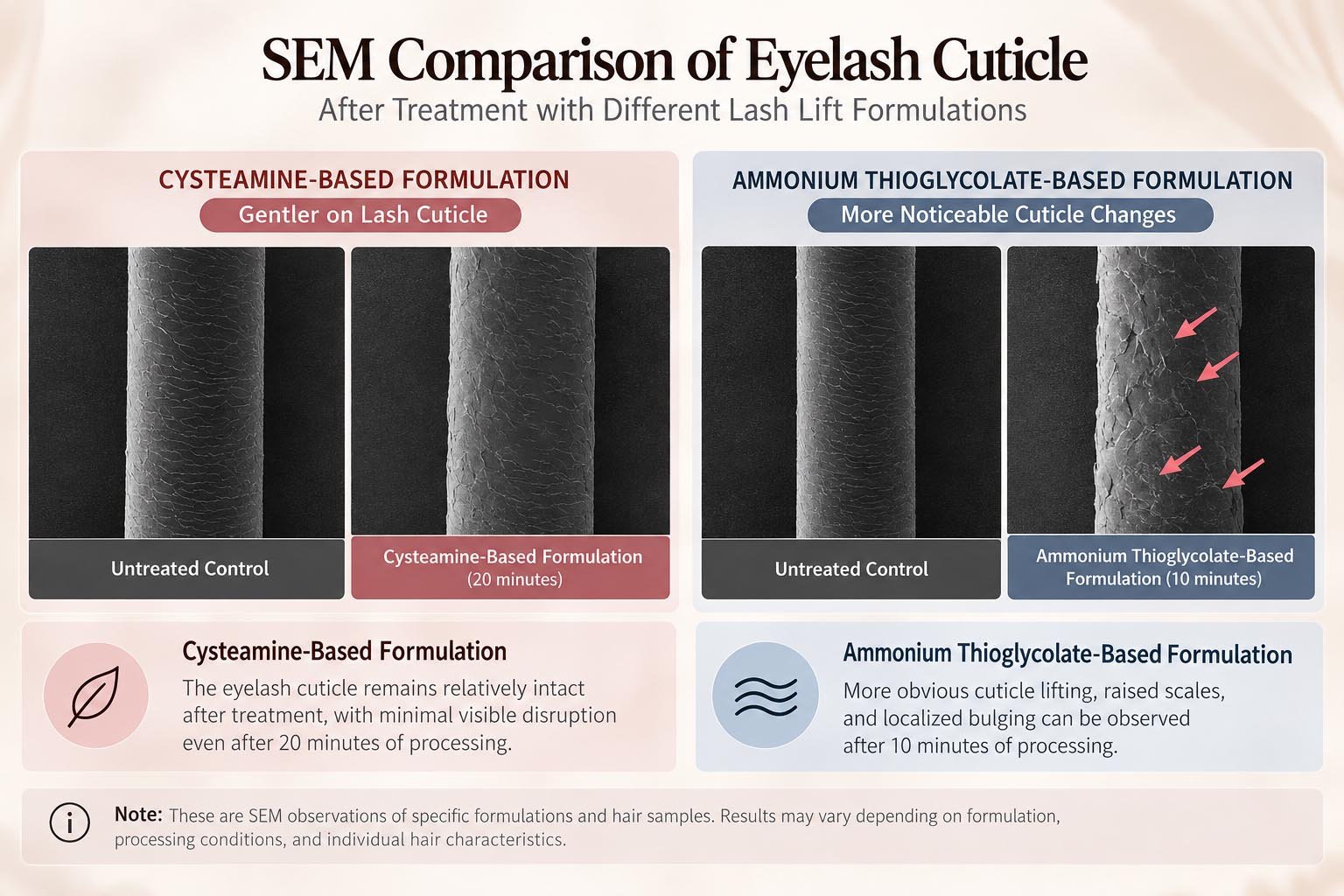
In these observations, the cysteamine-based formulation showed the most favorable cuticle preservation, with the lash cuticle remaining relatively intact even under extended experimental processing conditions. In contrast, ammonium thioglycolate-based formulations showed more pronounced cuticle lifting and localized bulging, while hybrid formulations produced more variable results across different hair samples.
These findings support the comparatively gentle characteristics of the tested cysteamine-based Korean lash lift formulation and help explain its emphasis on maintaining natural lash condition. However, they reflect the specific formulations and samples examined rather than a universal damage ranking for every commercial lash lift product.
For professionals, the practical advantage of a well-developed Korean lash lift system is the potential to achieve effective lifting with less visible cuticle disruption and a more forgiving processing window.
Korean lash lifts and keratin lash lifts are often compared, but they refer to different aspects of a lash lifting treatment.
Korean lash lift generally describes a lifting approach that emphasizes gentler chemical processing and maintaining natural lash condition. Many Korean systems use cysteamine-based Step 1 formulations.
Keratin lash lift, by comparison, usually emphasizes the inclusion of keratin or keratin-derived conditioning ingredients within the treatment system.
Keratin is a structural protein naturally present in eyelashes. In professional lash lift kits, hydrolyzed keratin and other conditioning ingredients are frequently included in Step 3 nourishing or conditioning treatments, which are designed to help maintain the feel and appearance of lashes after lifting and setting. Keratin-derived ingredients may also be included in other products within the kit, depending on the formulation.
However, keratin is not the reducing agent responsible for reshaping eyelashes. A keratin lash lift still requires suitable lifting and setting products to create a lasting change in lash shape.
Therefore, Korean, regular, and hybrid lash lift kits can all incorporate keratin-based conditioning products. The two terms are not mutually exclusive: Korean lash lift generally describes the lifting approach, while keratin lash lift highlights the conditioning components of the treatment.
Choosing between Korean and regular lash lift systems depends on the desired processing characteristics, natural lash condition, and professional treatment requirements.
For professionals prioritizing gentler processing and natural lash condition, a cysteamine-based Korean lash lift may be preferable. Its more gradual processing characteristics can offer a wider working window, helping professionals manage different lash types and application timing while reducing the risk of overprocessing.
For professionals prioritizing treatment efficiency, traditional rapid lash lift systems remain a practical option. Thioglycolate-based formulations can achieve excellent lifting results within shorter processing times, provided the recommended conditions are followed.
Hybrid systems combining different reducing agents offer additional formulation choices, although their performance and effects on lash condition depend on the specific product.
Ultimately, both Korean and regular lash lifts can produce comparable visual results. Their more meaningful differences lie in processing characteristics, potential effects on natural lash condition, and the degree of timing control required during treatment.
A Korean lash lift may offer advantages in gentler processing and preserving natural lash condition, particularly when using a well-developed cysteamine-based formulation. However, regular lash lift systems can achieve equally impressive visual lifting and curling results. The main difference is therefore not necessarily the final appearance, but the formulation's processing characteristics and potential impact on natural lashes.
Not necessarily. Both Korean and regular lash lifts can maintain visible lifting results for several weeks. Longevity depends on the complete lifting and setting system, application technique, and natural eyelash growth cycle rather than the Korean or regular designation alone.
A well-formulated Korean lash lift may offer gentler processing and less visible cuticle disruption than certain traditional formulations. However, minimizing hair damage requires correct application techniques, appropriate processing times, and compatibility between the Step 1 lifting lotion, Step 2 setting lotion, and other treatment products. Gentler processing does not eliminate the potential for chemical irritation or damage.
No. Korean lash lift generally refers to a lifting approach associated with gentler processing, while keratin lash lift emphasizes keratin-based conditioning ingredients, often included in Step 3 nourishing treatments. Korean, regular, and hybrid lash lift kits can all incorporate keratin conditioning products.
Both Korean and regular lash lifts can deliver beautiful, long-lasting lifting results. The key difference is not the final curl, but how each system processes natural lashes. Cysteamine-based Korean lash lifts generally emphasize gentler processing, better cuticle preservation, and a wider working window, while traditional thioglycolate-based systems often prioritize efficient lifting and shorter treatment times.
For professionals and lash brands, choosing the right system means balancing treatment efficiency, natural lash condition, and the needs of their target market.
At Mega Beauty, we manufacture Korean, traditional rapid, and hybrid lash lift systems for professional brands and distributors. With OEM/ODM manufacturing, private label packaging, and flexible kit configurations, we help businesses develop lash lift product ranges suited to their markets.
Looking to develop your own professional lash lift line? Contact Mega Beauty to explore custom formulations, private label lash lift kits, and wholesale manufacturing options.
No.18 B, Laoshan Road, Laoshan District, Qingdao City,Shandong Province
Copyright © 2025 Qingdao Mega Beauty Lashes Co., Ltd. All Rights Reserved.
