
Classic and hybrid lashes are two popular types of professional eyelash extensions. While classic lashes use a one-to-one application technique to enhance the natural lash line, hybrid lashes combine individual lash extensions with volume fans to create additional fullness, dimension, and texture.
However, the differences between classic and hybrid lashes go beyond a natural or voluminous appearance. The lash products used, the combination of individual extensions and fans, and the flexibility of lash styling all influence the finished result. Understanding these differences can help clients, lash artists, and lash brands make more informed choices.
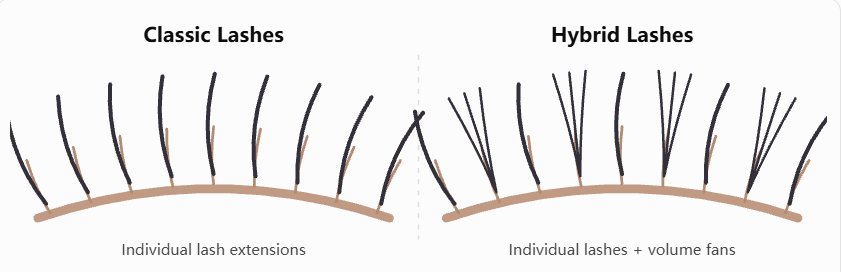
Classic lash extensions are applied using a one-to-one (1:1) technique, in which one individual extension is attached to one suitable natural lash. This technique enhances the existing lash line by adding length, curl, and definition while maintaining an individually separated appearance.
Hybrid lash extensions combine two application techniques within a single lash set: classic individual application and volume fan application. Some natural lashes receive individual extensions, while others receive fans consisting of multiple finer lash fibers.
Unlike classic lashes, hybrid lashes do not follow a fixed application ratio throughout the set. Lash artists can adjust the combination of individual extensions and volume fans according to the desired result.
| Feature | Classic Lashes | Hybrid Lashes |
|---|---|---|
| Application Technique | One-to-one (1:1) application | Combination of classic and volume applications |
| Lash Structure | Individual lash extensions | Individual extensions and multi-fiber fans |
| Appearance | Clean, defined, and individually separated | Fuller, more dimensional, and textured |
| Density | Largely dependent on natural lash density and extension diameter | Adjustable through individual extensions and volume fans |
| Styling Flexibility | Lash specifications and mapping | Lash specifications, mapping, fan selection, and combination ratios |
The fundamental difference is that classic lashes enhance the existing lash line through individual extensions, while hybrid lashes introduce additional design possibilities by combining different lash structures.
One of the most noticeable differences between classic and hybrid lashes is how lash density is achieved.
With classic lash extensions, the fullness of the finished set depends primarily on the client's natural lash density and the diameter of the individual extensions. Since each suitable natural lash receives only one extension, the number of extensions that can be applied is limited by the number of suitable natural lashes.
Using thicker individual extensions can create a darker, more defined appearance, but it does not increase the number of lash fibers. Consequently, a client with naturally dense lashes may achieve a relatively full classic set, while someone with fewer natural lashes may experience a lighter result.
Hybrid lashes offer greater flexibility in controlling visual density. By introducing multi-fiber fans alongside individual extensions, lash artists can increase the number of visible lash fibers and create broader coverage across the lash line.
The fullness of a hybrid set can be adjusted through several factors, including the proportion of volume fans, the number of fibers in each fan, and the width of the fans themselves.
In terms of definition and texture, classic lashes emphasize clean, individual lash lines, while hybrid lashes combine that definition with the softer fullness created by volume fans. This combination makes it easier to achieve a more dimensional and textured finish.
Unlike classic lash sets, hybrid lash sets can be customized by adjusting the proportion of classic individual extensions and volume fans.
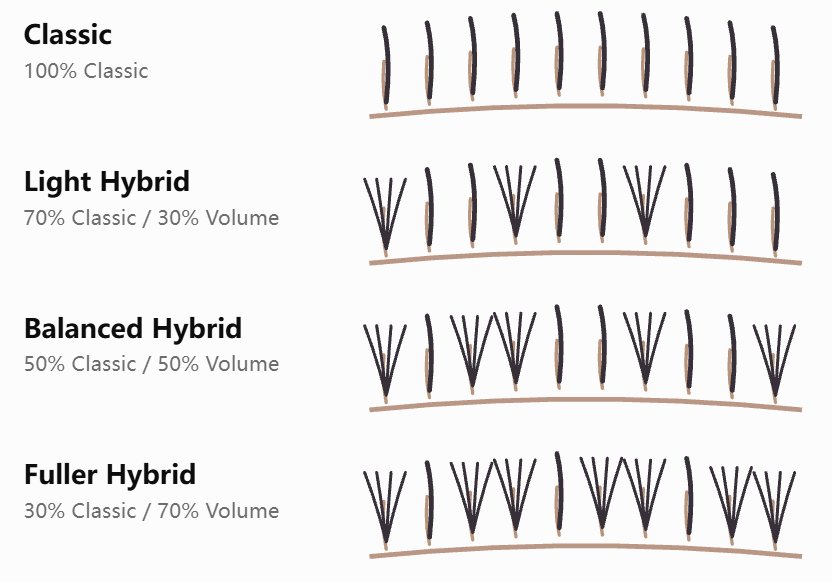
Common design approaches include:
| Classic-to-Volume Ratio | Visual Effect |
|---|---|
| 70% Classic / 30% Volume | A lighter hybrid look that retains more individual lash definition with added fullness |
| 50% Classic / 50% Volume | A balanced combination of classic definition and volume density |
| 30% Classic / 70% Volume | A fuller hybrid look that is closer to a volume lash set while retaining some individual definition |
These ratios refer to the proportion of application positions using individual extensions or volume fans, rather than the total number of extension fibers. They are examples of possible design combinations, not standardized hybrid lash classifications.
However, the application ratio alone does not determine the finished appearance.
For example, two hybrid lash sets may both use a 50:50 classic-to-volume ratio, but one may incorporate narrow 3D fans while the other uses wider 5D fans. Even with the same ratio, the resulting density, coverage, and texture can be noticeably different.
The diameter of the individual extensions, the length difference between individual lashes and fans, and their distribution across the lash line also contribute to the final design.
This flexibility allows hybrid lash sets to be tailored to a wide range of styling preferences rather than producing one predetermined look.
Lash Mapping
Both classic and hybrid lashes can achieve popular lash mappings such as Cat Eye, Doll Eye, Fox Eye, and Squirrel Eye. Since lash mapping is primarily determined by the arrangement and distribution of lash lengths across the eye, these designs are not restricted to a particular application technique.
Lash Styles
Classic and hybrid lashes share many styling possibilities, although the finished results can look quite different. Wispy lashes, for example, are often associated with hybrid applications, but classic lashes can also achieve a wispy look by combining individual extensions of different lengths. A classic wispy set typically features more defined and separated lash strands, while a hybrid wispy set can achieve a fuller, more dimensional appearance. Hybrid applications also make it possible to create certain fluffy, textured, and dramatic styles that are difficult to achieve with classic extensions alone.
Styling Versatility
The fundamental difference in styling versatility lies in the lash structures available for each technique. Classic applications rely on individual extensions, with variations in length, curl, diameter, and fiber profile shaping the finished look. Hybrid applications offer an additional dimension of customization by combining individual lashes with different types of multi-fiber extensions. This broader range of product combinations allows lash artists to create more diverse visual effects, making hybrid lashes generally more versatile in styling than classic lashes.
Classic and hybrid lashes do not necessarily require entirely separate product ranges. Many individual lash extension products can be used for both techniques, while hybrid applications introduce additional options through volume fans and specialized multi-fiber lash structures.
Traditional Classic Lashes
Traditional classic lash extensions generally feature individual fibers with a round cross-section and are commonly available in diameters of 0.10 mm and above.
These products are widely used to create complete classic lash sets. In hybrid applications, they serve as the individual lash component, providing definition and contrast alongside volume fans.
Depending on the styling design, individual extensions can blend into the overall lash line or stand out to create more noticeable length variations.
Flat Lashes
Flat lash extensions can also be used for both classic and hybrid applications. Unlike traditional round lashes, flat lashes feature a flattened cross-section that can provide a broader visual profile without necessarily requiring the same amount of fiber material as a comparable round lash.
In classic sets, flat lashes offer an alternative for achieving more pronounced individual definition. In hybrid sets, they can be combined with finer volume fans to create contrast between defined individual lashes and softer, fuller sections.
Both traditional round lashes and flat lashes offer different possibilities for achieving the desired individual lash appearance.
The volume component of hybrid lash extensions can be created using several types of professional lash products.
Traditional Volume Lashes
Traditional volume lashes consist of fine individual fibers that lash artists use to create handmade volume fans. This approach provides flexibility in adjusting the number of fibers per fan, fan width, and overall fan structure according to the styling requirements.
Easy Fan Lashes
Easy fan lashes are designed to facilitate the formation of volume fans during application. They offer a convenient alternative for lash artists who want to create fans more efficiently while retaining a degree of control over the finished fan structure.
Premade Volume Fans
Premade volume fans are pre-formed multi-fiber lash extensions with predetermined fiber counts and fan structures. They reduce the need for onsite fan creation and allow lash artists to select suitable fans according to their desired hybrid lash design.
Beyond the product type itself, several fan characteristics influence the finished hybrid set.
| Fan Characteristics | Influence on Hybrid Lash Sets |
|---|---|
| Fiber Count (D Count) | Determines the number of fibers added at each fan application position |
| Fiber Diameter | Influences individual fiber definition and overall fan weight |
| Fan Width | Affects horizontal coverage, spacing, and visual fullness |
| Fan Length | Helps control the relationship between the volume layer and individual lash peaks |
| Fan Base Structure | Influences the handling and attachment profile of the fan |
Together, these characteristics give lash artists different ways to adjust the volume component of a hybrid set, from subtle density enhancement to fuller, more textured designs.
In addition to conventional handmade and premade volume fans, specialized lash extension products such as YY, W, and U lashes can also be incorporated into hybrid applications.
These products feature multi-fiber structures with distinctive shapes and arrangements. Their different fiber configurations offer additional options for creating fullness, texture, and visual definition.
When combined with traditional classic lashes or flat lashes, YY, W, and U lashes can serve as the multi-fiber component of a hybrid set, providing alternatives to conventional volume fans.
However, it is important to distinguish between a hybrid look and a hybrid application technique.
A complete set created exclusively with YY, W, or U lashes may produce an appearance similar to certain hybrid styles. Nevertheless, if the set consists entirely of multi-fiber extensions without a combination of individual lash applications, it does not strictly follow the traditional definition of hybrid lash extensions.
For lash artists and lash brands, this distinction highlights the relationship between product structure and application technique. Different lash products can support similar styling goals without necessarily belonging to the same application category.
For a closer look at the distinction between specialized lash structures and hybrid application techniques, see our comparison of YY lashes vs hybrid lashes.
Although hybrid lashes often appear fuller than classic lashes, they are not necessarily heavier at each application position.
Traditional classic lash extensions generally use relatively thicker individual fibers, while volume fans are commonly formed from multiple finer fibers. As a result, a fan containing several fine fibers may weigh less than a single thicker classic lash, depending on its specifications.
The actual weight of lash extensions is influenced by several factors:
Fiber Diameter: Thicker fibers generally contain more material when other specifications remain comparable.
Fiber Length: Longer fibers generally weigh more than shorter fibers of the same material and structure.
Fiber Cross-Section: Round and flat lash fibers may contain different amounts of material at comparable nominal thicknesses.
Number of Fibers per Fan: The number of fibers contributes to the total weight of a volume fan.
Fan Base and Adhesive: The construction of the fan base and the amount of adhesive also contribute to the applied weight.
Both classic and hybrid lashes can provide a lightweight and comfortable wearing experience when appropriate products are selected. Visible fullness alone is not a reliable indicator of extension weight or the load placed on natural lashes.
Neither classic nor hybrid lashes inherently offer longer retention simply because of the application technique.
Lash extension retention depends on factors such as the natural lash growth cycle, adhesive performance, application quality, product selection, and aftercare.
However, classic and hybrid sets may change in appearance differently as extensions gradually shed. When an individual classic extension sheds with a natural lash, one extension fiber is lost. When a volume fan sheds, several extension fibers are lost at the same time.
The visibility of any resulting gaps depends on the original lash density, fan width, and the distribution of extensions throughout the set.
These differences influence how the lash set looks over time rather than necessarily determining how long the extensions remain attached.
Classic lash applications generally involve a more straightforward product selection and application process, as the entire set consists of individual extensions.
Hybrid applications require lash artists to select and combine individual extensions and volume fans while managing their distribution throughout the set. When handmade fans are used, additional time may be required for fan creation.
However, easy fan lashes, premade fans, and specialized multi-fiber lash products can help streamline this process. Application time therefore depends not only on the technique but also on product selection, styling complexity, and the lash artist's experience.
Hybrid lash services are often priced higher than classic lash services due to the additional product requirements, styling complexity, and potentially longer application time.
Actual prices vary between salons, locations, and service providers.
Both classic and hybrid lashes require regular infills and appropriate aftercare to maintain their appearance as natural lashes grow and shed. Neither technique eliminates the need for ongoing maintenance.
The choice between classic and hybrid lashes should begin with the desired appearance rather than the assumption that one technique is better than the other.
| Desired Result | Recommended Lash Type |
|---|---|
| A subtle, natural everyday enhancement | Classic Lashes |
| Clean, mascara-like lash definition | Classic Lashes |
| A natural look with additional fullness | Light Hybrid Lashes |
| A balance between individual definition and volume | Balanced Hybrid Lashes |
| A fluffy, layered, or textured appearance | Hybrid Lashes |
| A fuller lash line with pronounced individual peaks | Hybrid Lashes |
Both techniques can accommodate different eye shapes and mapping preferences. The main consideration is how much additional density, texture, and definition the client wants to achieve.
Natural lash characteristics are equally important when selecting an extension technique.
Clients with naturally dense lashes may achieve a relatively full and defined appearance with classic extensions alone. In this case, additional volume fans may not be necessary to achieve the desired result.
For clients with naturally sparse lashes, hybrid extensions may offer greater possibilities for increasing visual fullness. The wider coverage of volume fans can help reduce the appearance of spacing between lashes while retaining some individual definition.
However, sparse natural lashes should not be confused with fine or fragile natural lashes. Lash density describes the number and distribution of natural lashes, while lash strength and condition influence their ability to support extensions.
For clients with fine or fragile lashes, the suitability of either technique should be assessed by a professional lash artist based on the condition of the natural lashes and the weight of the selected extensions.
From a professional product perspective, classic and hybrid lash applications are complementary rather than entirely separate.
For lash artists, a well-organized selection of individual lash extensions can support both classic services and the individual component of hybrid sets. Adding suitable volume lashes and fans expands the range of density and styling options without requiring a completely separate collection of individual lash products.
For lash brands and distributors, this shared application provides a practical basis for developing a coordinated product range. Individual lashes in different diameters and finishes can establish the foundation, while volume lashes, premade fans, and specialized multi-fiber extensions offer additional styling possibilities.
Coordinating available lengths, curls, and fiber finishes across these collections can also help lash artists achieve more cohesive results when combining different products within a single hybrid set.
Rather than developing isolated product collections, brands can consider how different lash structures complement one another across multiple professional application techniques.
The main difference between classic and hybrid lashes lies in their application techniques and the styling possibilities they offer. Classic lashes enhance the natural lash line through individual definition, while hybrid lashes combine individual extensions and volume fans to provide greater control over density, texture, and dimension.
Both techniques offer a wide range of styling options. The appropriate choice depends on the desired appearance, natural lash characteristics, and the specifications of the extension products used.
As a professional lash extension manufacturer, Mega Beauty offers a comprehensive range of professional lash extensions, including classic lashes, flat lashes, volume lashes, easy fan lashes, premade fans, and specialized YY, W, and U lash extensions. These complementary product collections support lash brands, distributors, and professional salons in developing versatile lash extension ranges for classic, hybrid, and volume applications.
Laoshan Road, Laoshan District, Qingdao City,Shandong Province
Copyright © 2025 Qingdao Mega Beauty Lashes Co., Ltd. All Rights Reserved.
