
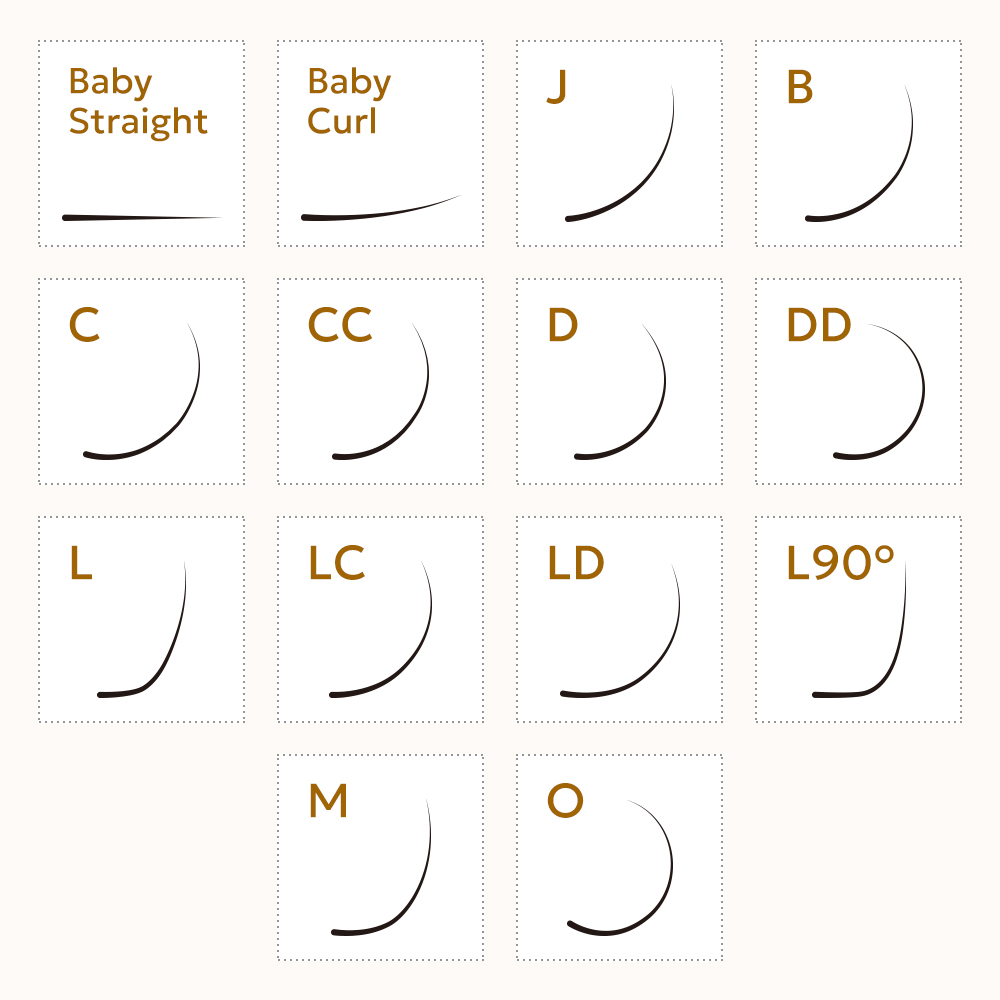
Lash extension curls describe the shape and degree of curvature of individual eyelash extension fibers**. Common lash extension curl types include Baby Straight, Baby Curl, J, B, C, CC, D, DD, L, M, LC, LD, L 90°, and O curls. Based on their overall shape and lifting effect, these different lash extension curls can generally be grouped into natural curls, standard curls, lift and specialty curls, hybrid lift curls, and extreme curls.
Each group creates a different balance of curvature, lift, and visual effect. J and B curls stay closer to the natural lash direction, while C, CC, D, and DD curls provide progressively stronger rounded curvature. L and M curls use flatter bases with more defined upward transitions, while hybrid profiles such as LC and LD combine a flatter base with a rounded upper curve. More specialized profiles, such as L 90° and O curl, are designed for stronger structural lift or extreme curvature.
Choosing between these curl types depends on the direction of the natural lashes, eye shape, desired lash style, and the length and thickness being used. In this guide, we compare the main lash extension curl types, provide a complete lash extension curl chart, explain how different curls look and perform, and show how to choose the right curl for different lash extension designs.
It is also important to note that curl letters are widely used throughout the lash industry, but their exact curvature is not completely standardized between manufacturers. A C, D, or M curl from one supplier may therefore differ slightly from the same labeled curl from another—a distinction we will explain later in this guide.
Lash extension curls refer to the pre-formed curvature built into individual eyelash extension fibers during manufacturing. The curl determines how the extension rises from its base, how strongly it curves upward, and the direction in which the tip appears when viewed from the front or side.
Curl is therefore one of the main specifications used to describe professional eyelash extensions. Two extensions with the same length and thickness can create noticeably different results when their curl profiles are different. A softer curl may extend more outward and create a natural appearance, while a stronger or more lifted curl can increase frontal visibility and produce a more open, dramatic, or elongated effect.
The shape of the curl also affects how an extension aligns with the natural lash. Natural lashes can grow upward, horizontally, or downward, so lash artists select different curls according to both the desired style and the direction of the client's natural lashes.
It is important not to confuse lash extension curls with lash lift curls. Lash extension curl describes the manufactured shape of a synthetic extension fiber, whereas a lash lift changes the curvature of the client's own natural eyelashes.
Letters such as J, B, C, CC, D, L, and M are industry naming conventions used to distinguish different curl profiles. They provide a practical way for lash artists and suppliers to identify the general shape and intensity of a curl.
For traditional rounded curls, the letters generally move from softer to stronger curvature. For example, J and B curls have relatively gentle curves, C and CC curls provide more noticeable lift, and D and DD curls create tighter, more dramatic curvature.
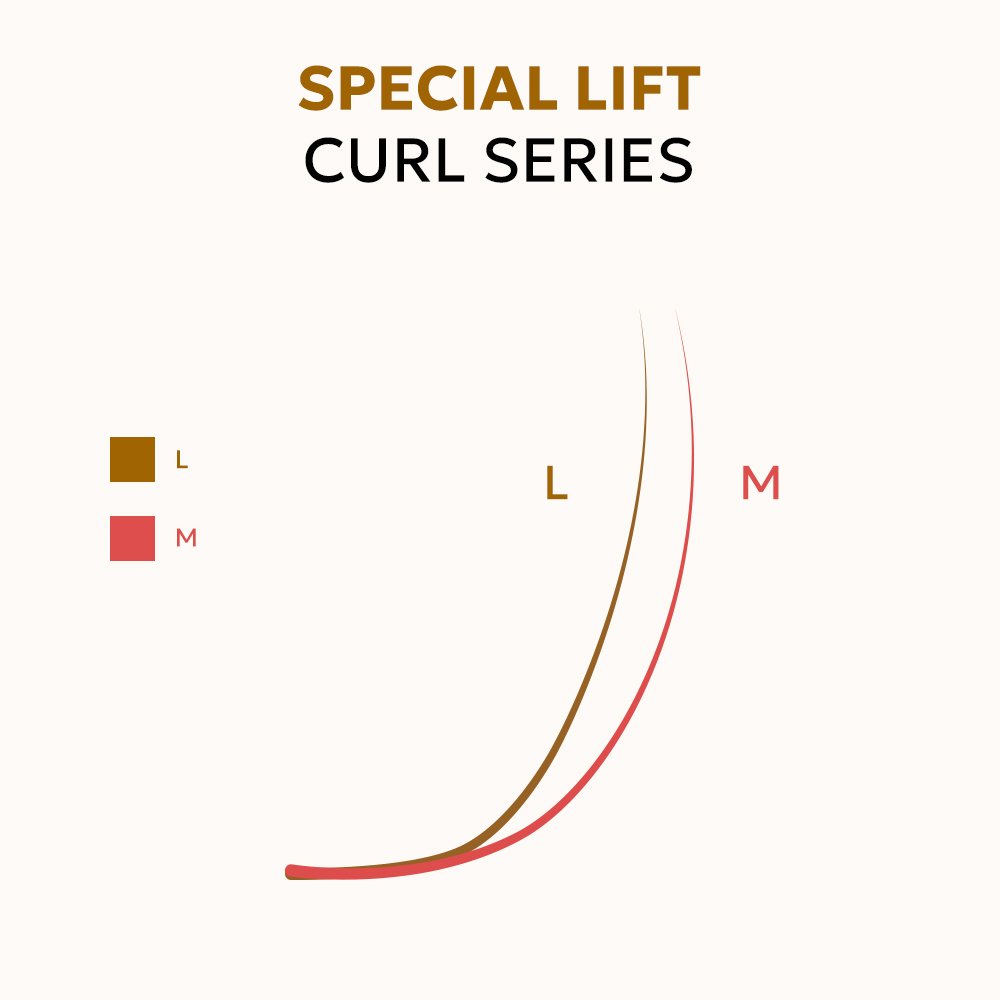
However, specialty curls such as L and M should not simply be viewed as “curlier” versions of C or D. Their geometry is different: they typically feature a straighter or flatter base followed by a more defined upward transition. Similarly, LC and LD curls combine characteristics of lift curls with the rounded upper profiles associated with C- and D-type curls.
For this reason, lash curl letters are best understood as shape categories rather than exact numerical measurements. The same curl designation can vary slightly between manufacturers, so the actual profile should also be considered when comparing products.
Different lash extension curls vary not only in how strongly they curve, but also in their overall shape. Traditional curls such as J, B, C, CC, and D follow a more rounded progression, while specialty curls such as L, M, LC, and LD use different base and transition structures to create more directional lift.
The chart below provides a quick comparison of the main lash extension curl types and their typical visual effects.
Lash Curl | Curl Profile | Curl Level | Visual Effect | Common Applications |
Baby Straight | Almost straight from base to tip | Very Low | Extremely natural, minimal lift | Lower lashes, ultra-natural sets |
Baby Curl | Very soft continuous curve | Very Low | Soft and natural | Natural and lightweight sets |
J Curl | Long straight base with a gentle tip curve | Low | Natural, elongated | Classic and natural lash sets |
B Curl | Soft gradual rounded curve | Low–Medium | Subtle lift and definition | Natural Classic and Hybrid sets |
C Curl | Balanced rounded curve | Medium | Open, defined and versatile | Classic, Hybrid and Volume sets |
CC Curl | Stronger rounded curve than C | Medium–High | More lifted and noticeable | Wispy, textured and Volume sets |
D Curl | Strong, pronounced rounded curve | High | Dramatic and eye-opening | Volume and dramatic lash styles |
DD Curl | Tight, highly curved profile | Very High | Strong lift and high drama | Mega Volume and bold lash sets |
L Curl | Flat base with a defined upward transition | High Lift | Sharp, lifted and elongated | Hooded eyes, downward lashes, eyeliner effects |
M Curl | Flatter base with a sweeping upward transition | High Lift | Lifted and elongated | Cat-eye, fox-eye and lifted styles |
LC Curl | Flat base transitioning into a C-like curve | Medium–High Lift | Soft lift with rounded tips | Corrective and natural lifted styles |
LD Curl | Flat base transitioning into a D-like curve | High Lift | Strong lift with dramatic tips | Corrective and dramatic Volume styles |
L 90° Curl | Flat base with a sharp upward transition | Very High Lift | Strong vertical, structural effect | Specialty and corrective styling |
O Curl | Extremely tight rounded curve | Extreme | Highly curled and dramatic | Specialty, editorial and high-impact styles |
Note: Curl names describe general lash profiles rather than universally fixed measurements. The exact curvature of a C, D, L, or other curl may vary slightly between eyelash extension manufacturers. When comparing products from different suppliers, the physical curl profile is more reliable than the curl letter alone.
Curl is only one part of an eyelash extension specification. Fiber diameter also affects the weight and application of the extension; see our lash extension thickness guide for a detailed comparison of common diameters.
Different lash extension curl types can be grouped according to their overall curvature, base shape, and lifting effect. Some curls are designed to follow the natural lash direction with minimal lift, while others create stronger rounded curvature or use flatter bases and angled transitions for more directional styling.
Understanding these differences helps lash artists choose the right curl for the natural lash direction, eye shape, and desired lash style.
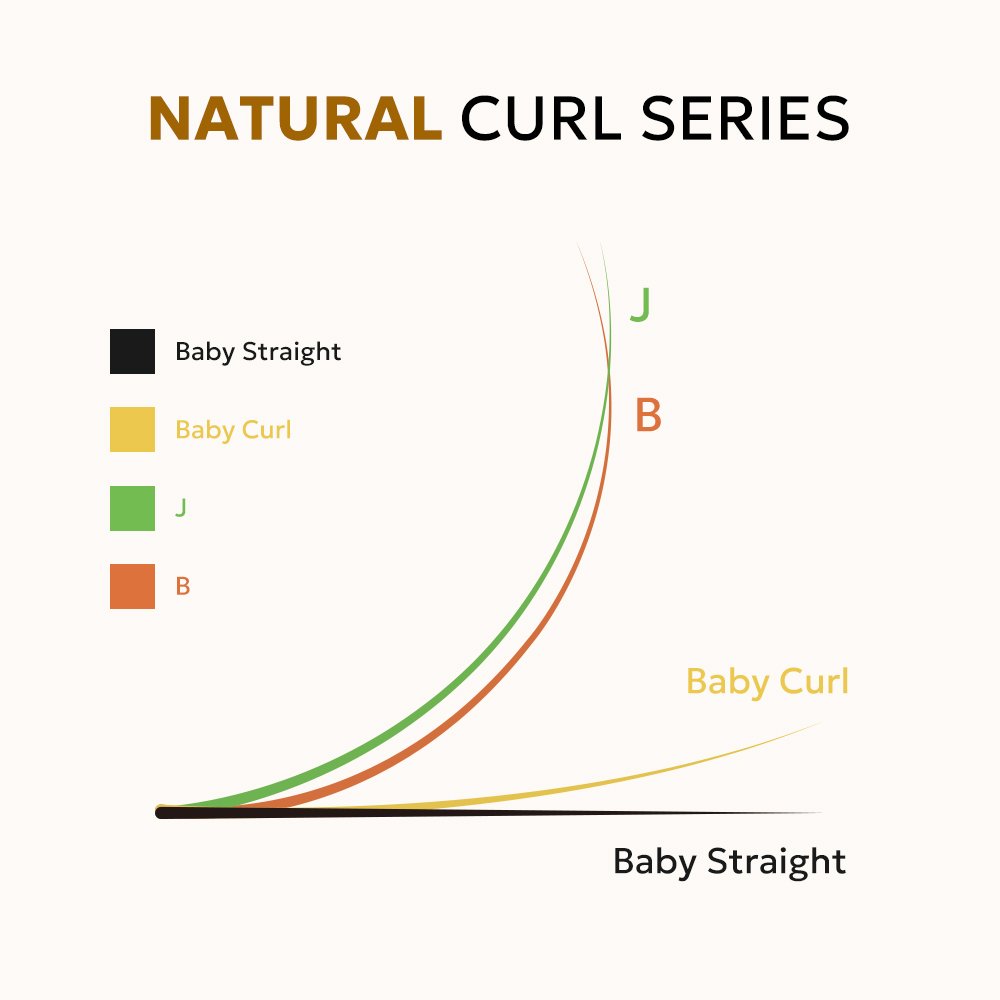
Natural lash curls create the softest curvature in the lash extension curl range. They generally follow the direction of natural eyelashes more closely and are suitable when subtle enhancement is preferred over a strong lifted effect.
Baby Straight has almost no visible curvature, maintaining a nearly straight profile from the base toward the tip. It creates an extremely subtle extension effect and can be used for lower lashes or styles where minimal curl is required.
Baby Curl introduces a very gentle, continuous curve while remaining close to the natural lash direction. Compared with Baby Straight, it provides slightly more lift without creating an obviously curled appearance, making it suitable for soft and lightweight natural sets.
J Curl has a relatively straight base and develops a gentle upward curve toward the tip. It adds length and subtle definition while keeping the overall result natural. J Curl works particularly well with straight or slightly upward-growing natural lashes and is commonly used for understated Classic sets.
B Curl provides more visible curvature than J Curl while still maintaining a soft appearance. Its gradual rounded shape creates a light lifting effect without the stronger frontal curl associated with C or D profiles. It is a versatile option for natural Classic and Hybrid lash designs.
Overall, the progression from Baby Straight to Baby Curl, J, and B Curl represents a gradual increase in visible curvature and lift. These profiles are useful when the goal is to enhance the natural lash line rather than create a noticeably dramatic curl.
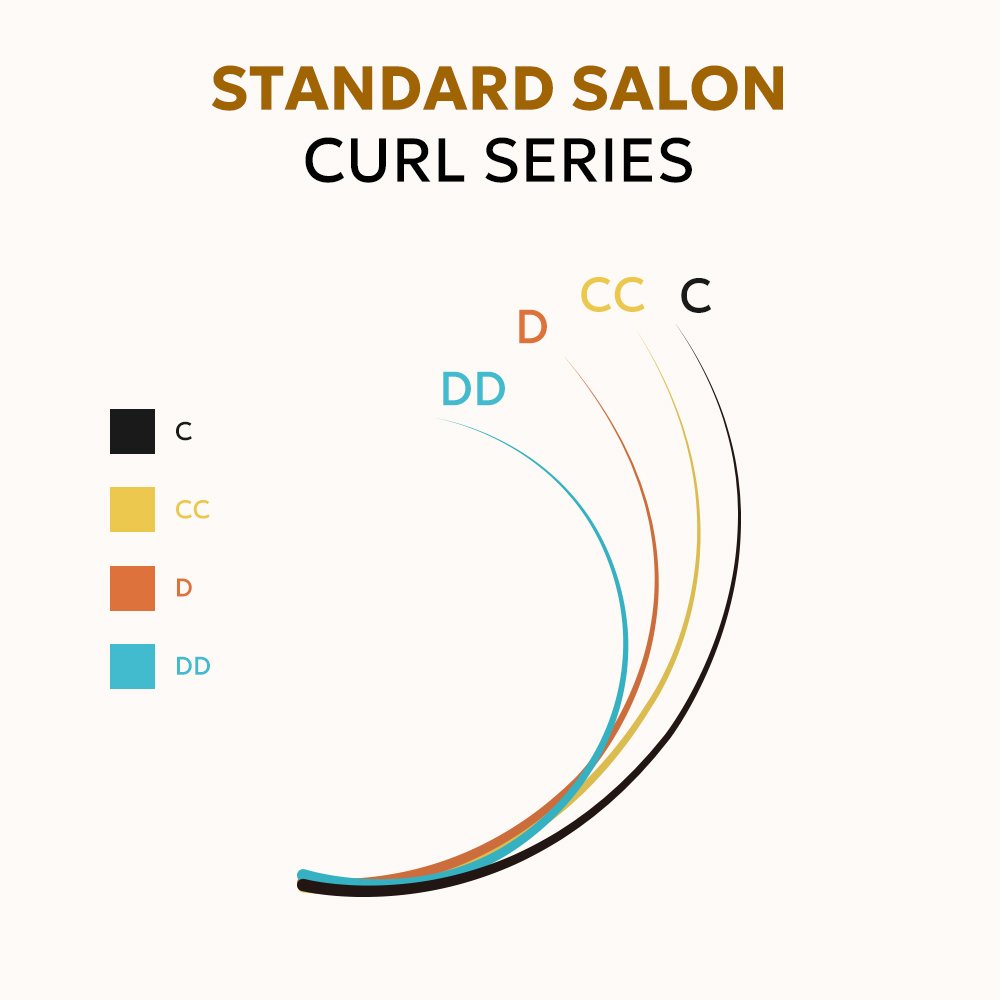
C, CC, D, and DD are rounded **lash extension curls** that provide progressively stronger curvature and frontal visibility. They are widely used across Classic, Hybrid, Volume, and more dramatic lash designs.
C Curl features a balanced, rounded curve that provides noticeable lift without appearing excessively curled. It creates an open and defined effect while remaining versatile enough for natural and fuller lash styles. For this reason, C Curl is commonly used across Classic, Hybrid, and Volume sets.
CC Curl sits between C and D in overall curvature. It provides stronger lift and greater frontal visibility than C Curl while remaining softer than a typical D Curl. This makes it useful for wispy, textured, and Volume designs that need additional definition without an extremely tight curl.
D Curl has a stronger and more pronounced rounded profile. Its increased curvature directs more of the extension upward, creating a dramatic, eye-opening appearance. It is frequently used for Volume, doll-eye, and other styles where a clearly lifted result is desired.
DD Curl takes the rounded profile further with a tighter, more dramatic curve. It creates strong frontal visibility and a highly curled appearance, making it better suited to bold, high-impact or Mega Volume designs than subtle natural sets.
From C to CC, D, and DD, the rounded curvature generally becomes progressively stronger. However, the exact difference between these curl labels can vary by manufacturer, so physical samples should be compared when precise curl matching is required.
Unlike traditional rounded curls, L and M curls use a straighter or flatter base followed by a more defined upward transition. This geometry creates directional lift and makes these curls particularly useful for styling straight or downward-growing natural lashes.
L Curl begins with a relatively flat base before transitioning into a distinct upward direction. The flatter attachment area follows straight natural lashes closely, while the upper section creates a clean, lifted appearance. Its more geometric profile is often used for eyeliner effects, lifted cat-eye designs, and clients with straight or downward-growing lashes.
M Curl also provides strong lift but typically transitions into a smoother, more sweeping upper profile. This combination creates both upward lift and visual elongation, which makes M Curl particularly useful for modern cat-eye and fox-eye mappings.
Although both L and M belong to the lift-curl family, their transition shapes create different styling effects. L tends to produce a more defined geometric lift, while M creates a smoother lifted and elongated appearance.
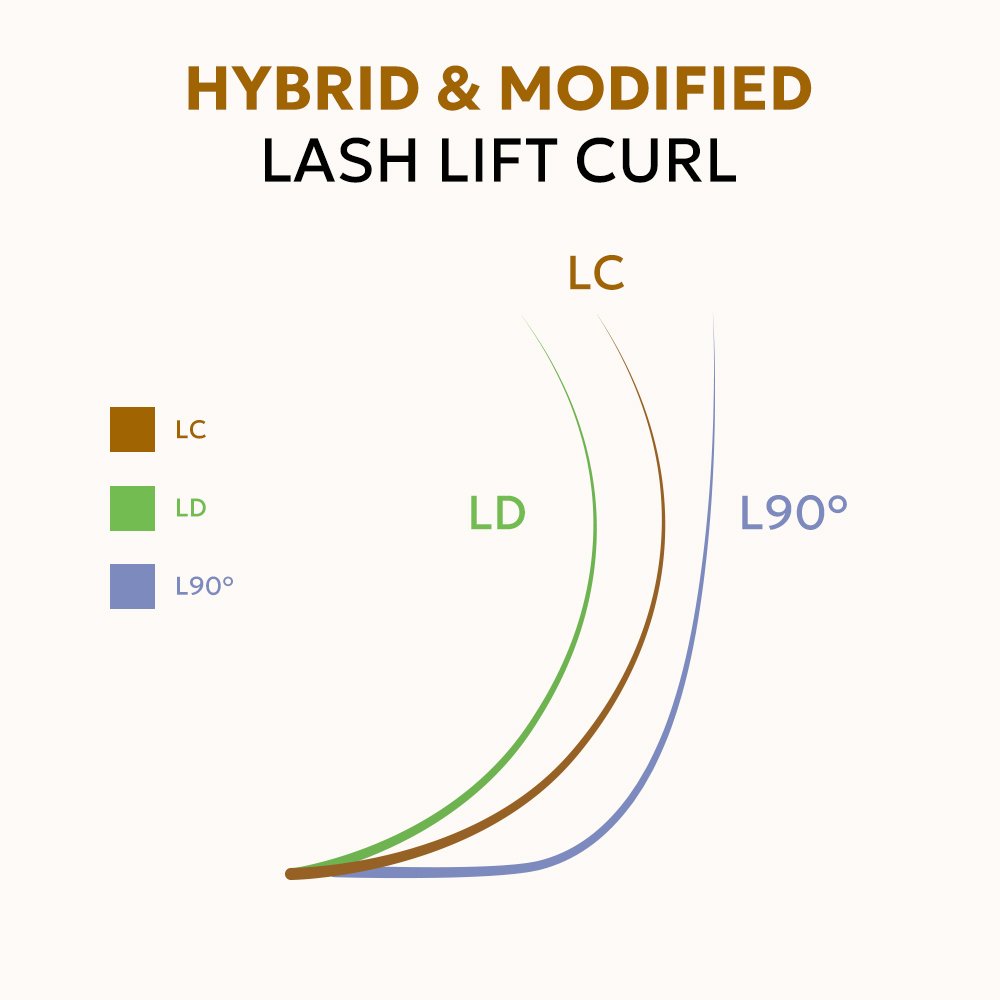
Hybrid and modified lift curls build on the flat-base concept while changing the shape of the upper section. These profiles provide additional options when a standard rounded curl or conventional L/M curl does not create the desired result.
LC Curl combines a flatter base with a softer, C-like curve through the upper portion of the extension. It provides the structural lift associated with flat-base curls while maintaining a rounded, softer-looking tip. This makes it useful for downward-growing natural lashes when a less angular result is preferred.
LD Curl follows a similar concept but transitions into a stronger, D-like upper curve. The result combines a flatter base with greater vertical lift and a more dramatic rounded finish, making it suitable for lifted Volume and higher-impact styles.
L 90° Curl uses a much sharper upward transition than a conventional L Curl. Its highly structured profile produces strong vertical lift and is generally used for specialized or corrective lash styling rather than everyday natural sets.
The main difference within this group is therefore the upper trajectory of the extension: LC finishes with a softer curve, LD provides a stronger rounded lift, and L 90° creates a much sharper vertical transition.
O Curl represents the most extreme rounded profile in this curl range. It forms a very tight arc with substantially more curvature than standard C, D, or DD curls.
The highly curled shape creates a bold, stylized appearance with strong visual depth. Because of its extreme curvature, O Curl is generally used for specialty lash artistry, editorial designs, or clients specifically seeking a highly curled effect rather than conventional everyday lash sets.
While O Curl sits at the dramatic end of the spectrum, it should not be viewed simply as the “best” or “strongest” curl. As with every lash extension curl, the appropriate choice depends on the natural lash direction, eye shape, and intended styling effect.
Choosing the right lash extension curl is not simply about selecting the strongest or most dramatic curve. The best curl should work with the direction of the natural lashes, complement the client’s eye shape, and create the intended styling effect.
Because the same curl can look different on different clients, lash artists often use these factors together rather than choosing a curl based on its letter alone.
The direction of the natural lashes is one of the most important factors when selecting an extension curl. A curl that aligns well with the natural lash can create a smoother transition between the natural lash and the extension.
Upward-growing natural lashes: Softer curls such as J, B, or C can provide enough visible lift without making the result appear excessively curled.
Straight natural lashes: B, C, or CC curls are common options for adding visible curvature while maintaining a balanced transition.
Downward-growing natural lashes: Stronger lift or flat-base profiles such as CC, D, L, M, LC, or LD can help bring the extensions into greater frontal visibility.
Curl selection should still be adjusted according to the individual lash line. Two clients with downward-growing lashes, for example, may require different curl profiles depending on how strongly the natural lashes point downward and the final style they want.
Eye shape and eyelid structure influence how much of the lash curl is visible from the front. Instead of assigning one fixed curl to every eye shape, lash artists can use different curl profiles to enhance, lift, open, or visually elongate the eyes.
| Eye Shape / Feature | Common Curl Options | Styling Consideration |
|---|---|---|
| Almond Eyes | C, CC, D, M | Versatile shape that works with natural, open-eye, cat-eye, and elongated designs |
| Round Eyes | B, C, CC, L, M | Softer or elongated curls can help avoid adding excessive roundness |
| Hooded Eyes | C, CC, L, M, LC | Lift and frontal visibility are important where the eyelid partially covers the lash line |
| Monolid Eyes | C, L, M, LC | Lift-oriented profiles can help extensions remain visible above the eyelid |
| Deep-Set Eyes | C, CC, D, L, M | Curl choice should consider the distance between the lash line and brow bone |
| Downturned Outer Corners | C, CC, D, M | Strategic curl placement can create a more lifted outer appearance |
These are general styling references rather than fixed rules. Natural lash direction, eye proportions, lash mapping, and the client's desired result should all be considered together.
Different lash extension curls can also change the overall character of a lash set. The same lash map can appear softer, more open, more dramatic, or more elongated simply by changing the curl profile.
For soft, understated results, J, B, and C curls are common choices. They follow the natural lash line more closely and create definition without excessive upward curvature.
C, CC, and D curls can create stronger frontal visibility and help emphasize the center of the eye. Curl intensity can be adjusted depending on how dramatic the finished set should appear.
Cat-eye mappings often use C, CC, L, or M curls, depending on whether the goal is a softer elongated effect or a sharper, more lifted outer line.
Lift curls such as L and M are particularly useful for creating the stretched, lifted direction associated with fox-eye styling. Their flatter bases and directional upper profiles can produce a more defined outer sweep than conventional rounded curls.
Wispy sets are not limited to one curl. C, CC, D, L, and M curls can all be used depending on the desired texture, and lash artists may combine multiple curls to create more noticeable variation between the base layer and spikes.
Ultimately, there is no single lash extension curl that is best for every client. The right choice comes from balancing natural lash direction, eye structure, and desired styling effect. In some designs, that may also mean using more than one curl within the same lash set rather than applying a single curl across the entire lash line.
Yes. Different lash extension curls can be mixed within the same lash set** to create smoother transitions, adjust lift in different areas of the eye, or achieve more dimensional styles. Lash artists are not limited to using a single curl from the inner corner to the outer corner.
Mixing curls is particularly useful because natural lashes do not always grow in the same direction across the entire lash line. Inner lashes may be straighter, while the center and outer lashes may grow at different angles. Using different curls allows the finished set to respond more precisely to these variations.
Different curls can be combined for several styling purposes:
Create smoother transitions:Softer curls can be used in the inner corner before transitioning into stronger curls through the center or outer section.
Adjust lift:Stronger or specialty curls can be placed where additional frontal visibility or upward lift is needed.
Create texture:Different curls can help separate spikes from the base layer in wispy and textured lash sets.
Shape the eye:Curl placement can support open-eye, cat-eye, fox-eye, or lifted outer-corner effects.
Work with different natural lash directions:The curl can be adjusted across the lash line when natural lashes grow at different angles.
Some commonly used combinations include:
Creates a soft transition from a more natural inner corner into a slightly more lifted main lash line. This combination works well for subtle, natural-looking sets.
Provides a gradual increase in lift while maintaining a rounded overall shape. It is a versatile combination for Classic, Hybrid, and soft Volume styles.
Allows the lash artist to build progressively stronger curvature in selected areas. This combination can be used for open-eye, doll-eye, wispy, and more dimensional designs.
Combines the softer appearance of traditional rounded curls with the directional lift of specialty curls. L or M profiles can be introduced strategically to create a more lifted or elongated outer section.
There is no universal formula for mixing lash extension curls. The combination should be selected according to the client’s natural lash direction, eye structure, and desired lash map, while keeping transitions between different curl profiles visually balanced.
For this reason, multi-curl styling is best viewed as a technique for controlling the shape of the complete lash set rather than simply combining stronger and weaker curls.
Although both involve eyelash curvature, lash extension curls and lash lift curls refer to two different concepts.
A lash extension curl is a pre-formed shape built into the eyelash extension fiber during manufacturing. Curl types such as J, B, C, CC, D, L, and M represent different extension profiles with recognizable differences in curvature, base shape, and lifting effect.
A lash lift, however, creates curl by shaping the client’s natural eyelashes over a silicone shield or rod during the lifting process. Lash lift shields are commonly labeled with sizes such as S, M, and L, and some suppliers also offer additional sizes such as XS or XL. These labels generally describe the size and curvature of the silicone shield rather than standardized lash curl types. The same labeled shield size can also differ in shape and curvature between manufacturers.
In short, lash extension curls are pre-formed fiber profiles with distinct curl categories, while lash lift curvature is created on natural lashes and depends largely on the shape and size of the silicone shield used.
No. Although curl names such as J, B, C, CC, D, L, and M are widely used throughout the eyelash extension industry, there is no universal measurement standard that requires every manufacturer to produce exactly the same curvature for each curl name.
This means that a C Curl from one manufacturer may look slightly more or less curved than a C Curl from another, and the same applies to D, L, M, and other lash extension curl types.
The final curl profile is influenced by several manufacturing variables, including the shape and dimensions of the forming mold, PBT fiber characteristics, heat-setting conditions, and production tolerances. Even small differences in these factors can change the curvature, transition point, or overall shape of the finished extension.
Manufacturers may also develop and maintain their own curl specifications. As a result, curl letters are useful for identifying the general type of curl, but they should not be treated as exact universal measurements.
For lash brands sourcing from a manufacturer, physical samples provide a more reliable reference than curl letters alone. Once the desired curl profile has been confirmed, an approved sample can be retained as the reference standard for future production.
When evaluating subsequent batches, the manufacturer can compare the curl profile against this approved reference to control differences in curvature and maintain greater batch-to-batch consistency.
This is especially important when changing eyelash extension suppliers or developing a custom lash extension range. Rather than assuming that a supplier’s C, D, or M Curl will exactly match an existing product, brands should compare actual samples and confirm the curl profile before bulk production.
Most lash extension curls are formed by fixing PBT fibers around shaping tubes and then heat-setting them into the required curvature. The shape and dimensions of these tubes play a major role in determining the final lash curl.
For traditional rounded curls such as J, B, C, CC, D, and DD, manufacturers generally use round tubes with different diameters to form different levels of curvature. The diameter of the forming tube affects the curvature of the fiber: different tube sizes create tighter or looser curl profiles according to the manufacturer’s curl specifications.
Specialty curls such as L and M cannot be produced with the same simple round-tube geometry. Instead, specially shaped forming tubes or molds are used to create their characteristic straighter bases and defined upward transitions. Hybrid profiles such as LC and LD may also require corresponding specialty forming structures.
The basic manufacturing process involves arranging and securing the lash fibers tightly and evenly around the appropriate curl tube, followed by controlled heat setting. During heating, the PBT fibers take on the shape of the forming tube. After the fibers have been properly heat-set and cooled, they retain the intended curl when removed from the tube.
Several production variables can affect the final lash extension curl and its consistency:
Forming tube diameter and shape: Determines the basic curvature and geometry of the curl.
Fiber wrapping tension:Fibers wrapped too tightly or too loosely can produce differences in the finished curvature.
Heat-setting temperature:Insufficient or excessive temperature can affect how accurately the fiber retains the intended shape.
Heat-setting time:The duration of heating also influences how completely the curl is set.
PBT fiber properties:Different fiber specifications can respond differently to shaping and heat.
Fiber positioning:Uneven alignment on the forming tube can lead to inconsistent curl direction or shape.
Cooling and release:Stable cooling before the fibers are removed helps preserve the formed curvature.
Because lash curls are shaped through a combination of forming-tube specifications, wrapping control, and heat-setting parameters, maintaining the same production standards is essential for consistent curls across different batches.
Mega Beauty manufactures eyelash extensions in a wide range of standard and specialty curl specifications for wholesale and private label production.
For lash brands, sourcing eyelash extensions involves more than checking whether a manufacturer offers common curls such as C, CC, D, L, or M. Because lash extension curl profiles are not universally standardized**, brands should evaluate the actual curl shape, consistency, and manufacturing capability behind each specification.
First, check whether the manufacturer can supply the curl range required for your product line. A comprehensive supplier may offer standard curls such as J, B, C, CC, D, and DD, as well as specialty curls including L, M, LC, and LD.
Curl availability should also be considered together with other specifications such as length, thickness, fiber type, and lash extension style, especially when building a complete product range.
Consistency is particularly important for established lash brands. The same curl should maintain a similar profile across different production batches so that customers do not receive noticeably tighter or looser curls when reordering the same product.
Brands can evaluate this through samples and repeat orders, while manufacturers should control key production variables such as forming-tube specifications, wrapping tension, heat-setting temperature, and processing time.
Since curl letters alone cannot guarantee an exact match between suppliers, brands should confirm the physical curl profile with samples before bulk production.
If you already have an existing curl specification, a manufacturer can use your approved sample as a reference for matching and production control. For brands developing a differentiated lash extension range, manufacturers with flexible forming and production capabilities can also develop custom curl profiles based on the required base shape, curvature, and lifting effect.
For long-term sourcing, the goal is not simply to find a supplier offering the right curl letters, but to find an eyelash extension manufacturer capable of reproducing the required curl profile consistently from one batch to the next.
Common lash extension curl types include Baby Straight, Baby Curl, J, B, C, CC, D, DD, L, M, LC, LD, L 90°, and O Curl. They range from soft, natural curves to stronger rounded curls and specialty lift profiles. C, CC, and D are among the most widely used curls, while L and M are designed with flatter bases and stronger upward transitions.
C Curl is one of the most commonly used lash extension curls because it provides a balanced combination of natural curvature and visible lift. CC and D curls are also widely used when a stronger or more dramatic effect is required.
J, B, and C curls are commonly used for natural-looking lash extension sets. J and B provide softer curvature, while C offers more visible lift while still maintaining a relatively natural appearance. The best choice also depends on the direction and curvature of the client’s natural lashes.
C, CC, L, M, and LC curls can all be used for hooded eyes depending on the natural lash direction and desired style. L and M curls are particularly useful when stronger frontal lift is needed** because their flatter bases transition into a more pronounced upward direction.
Yes. Lash artists can mix different lash extension curls within the same set to create smoother transitions, control lift in different areas, or achieve specific styles such as wispy, cat-eye, and fox-eye looks. Common combinations include B + C, C + CC, and C + CC + D.
Not necessarily. There is **no universal standard defining the exact curvature of each lash extension curl**, so a C, D, L, or M Curl can vary slightly between manufacturers. Lash brands should compare physical samples rather than relying only on curl letters when changing suppliers or matching an existing product.
Understanding the different lash extension curl types makes it easier to select the right profile for different natural lash directions, eye shapes, and desired lash styles. From softer J and B curls to widely used C, CC, and D curls, as well as specialty profiles such as L and M, each curl creates a different balance of curvature, lift, and visual effect.
However, lash curl letters are not based on a universal manufacturing standard. The actual profile of the same curl can vary between suppliers, making physical samples and batch-to-batch consistency especially important for lash brands.
As a professional eyelash extension manufacturer, Mega Beauty offers a wide range of standard and specialty lash curls, along with custom specifications and OEM/private label production for lash brands and wholesalers. We can also match existing curl samples or develop custom curl profiles for your product line.
Looking for consistent lash extension curls for your brand? Contact Mega Beauty to request samples or discuss your custom eyelash extension requirements.
No.18 B, Laoshan Road, Laoshan District, Qingdao City,Shandong Province
Copyright © 2025 Qingdao Mega Beauty Lashes Co., Ltd. All Rights Reserved.
